
May 4, 2026
Travel disruptions are no longer rare - they're the new normal. Flight cancellations, extreme weather, and geopolitical events now affect most travelers. But here's the problem: most travel insurance policies are outdated and fail to address these frequent issues.
Key problems with current travel insurance include:
Solutions like parametric insurance and embedded coverage are changing the game. These modern approaches offer:
Travel insurance needs to evolve to meet the demands of today's unpredictable travel landscape. Automating claims and embedding coverage directly into bookings are steps in the right direction.
In March 2026, global systems recorded over 31,000 delays and cancellations, highlighting the ongoing strain on the aviation industry [5][7]. Modern air travel operates with very little room for error. Airlines have cut back on spare aircraft and crew to save costs, which means a single delayed flight can lead to a domino effect, causing six or more cancellations. Without a buffer to absorb these disruptions, the system falters quickly. Add to this the ongoing air traffic control staffing shortages, outdated ground systems, and congestion at major hubs like Atlanta Hartsfield-Jackson, and it becomes clear why even routine stresses can overwhelm the network [5]. These challenges, combined with economic pressures, have set the stage for airline bankruptcies and widespread delays.
In Europe, air traffic control delays have more than doubled in the last decade [5]. In the U.S., infrastructure projects like the runway construction at San Francisco International Airport have reduced arrival rates by as much as 33% [5]. These operational bottlenecks, coupled with rising jet fuel costs and other financial pressures, have left many airlines teetering on the edge of bankruptcy [1][5].
Airlines aren't always required to reimburse expenses related to delayed or canceled flights outside of their control, particularly when disruptions are caused by security concerns, weather events, or government action
.
This lack of accountability often leaves passengers to shoulder the costs of disruptions that fall outside airline liability. Traditional insurance policies often fail to fill this gap, leaving travelers exposed.
External factors, particularly climate change, are further complicating travel. Extreme weather events, from winter storms to unexpected monsoons, have become the norm, stranding over 120,000 travelers in April 2026 alone [6].
The industry's response has been largely reactive. For instance, during the 2025 hurricane season, 43% of weather-related insurance claims were denied under "foreseeable weather" clauses [6]. Since 2024, consumer complaints about denied claims have risen by 67% [6]. At the same time, insurers have increased premiums by 28% annually while slashing maximum payouts. Some policies now cap reimbursements at just $200 per traveler - barely enough to cover a single night's hotel stay during a prolonged delay [6].
Compounding these issues are destination restrictions. By 2026, 71% of travel insurance policies excluded coverage for pandemics or epidemics [8]. Popular destinations are also introducing sudden visitor taxes, lodging fees, and capacity limits to combat overtourism, leaving travelers unprotected. As Christina Tunnah, Head of the Americas at World Nomads, explained:
Most travel insurance will not cover the liabilities of another entity, whether that be an operator or an airline
.
These layered disruptions emphasize the growing need for embedded, real-time insurance solutions to protect travelers in an increasingly unpredictable landscape.
In today’s travel landscape, disruptions like delays, cancellations, and extreme weather have become the norm. Yet, traditional travel insurance hasn’t kept pace with these changes. One of the biggest weaknesses is the outdated claims process, which often leaves travelers frustrated and financially strained when they need help the most.
The claims process for legacy travel insurance is notoriously slow and cumbersome. Travelers are required to gather a mountain of paperwork - boarding passes, receipts, and confirmations - just to start a claim. This process can drag on for days or even weeks before reimbursement is issued, leaving travelers in a financial bind when they need immediate funds [4][10].
Adding to the frustration, claims are frequently denied due to incomplete documentation, missing receipts, or technicalities like needing to first seek compensation from airlines. Even when claims are approved, the payout often falls short of expectations. Many policies calculate reimbursements based on the depreciated value of items instead of their original cost, forcing travelers to cover the shortfall out of pocket [4].
"Legacy systems in the insurance industry cannot personalize policies. They also cannot automate claims, and they do not offer robust security." - Intellias
For someone stranded in an unfamiliar city, waiting weeks for reimbursement isn’t just inconvenient - it can be a major financial burden. Immediate access to funds is essential for rebooking flights, securing accommodations, or replacing lost essentials.
Another major flaw in traditional travel insurance is the lack of automation for common travel disruptions. For instance, when a flight is delayed beyond a certain threshold, airlines and flight tracking APIs already have that information readily available. However, legacy policies still require travelers to manually file a claim and provide proof of the delay [10].
These policies are also limited in scope, covering only a narrow range of "specified triggers", such as severe illness or natural disasters [4][9]. Modern challenges like air traffic delays or heightened security measures often fall outside these definitions, leaving travelers without coverage for increasingly frequent disruptions [4][9].
"Traditional flight delay insurance depends heavily on manual claims processing... This creates a poor customer experience and high administrative costs for insurers." - Belle Chen, Digital Marketing Manager at VariFlight
Despite the availability of advanced technologies, only 10% of major insurance providers have modernized more than half of their outdated systems [11]. Automated parametric systems, for example, can verify disruptions like flight delays in real-time and issue payouts in under 30 minutes [10]. Yet, most insurers have been slow to adopt these innovations, leaving travelers stuck with outdated processes that fail to meet the demands of modern travel.
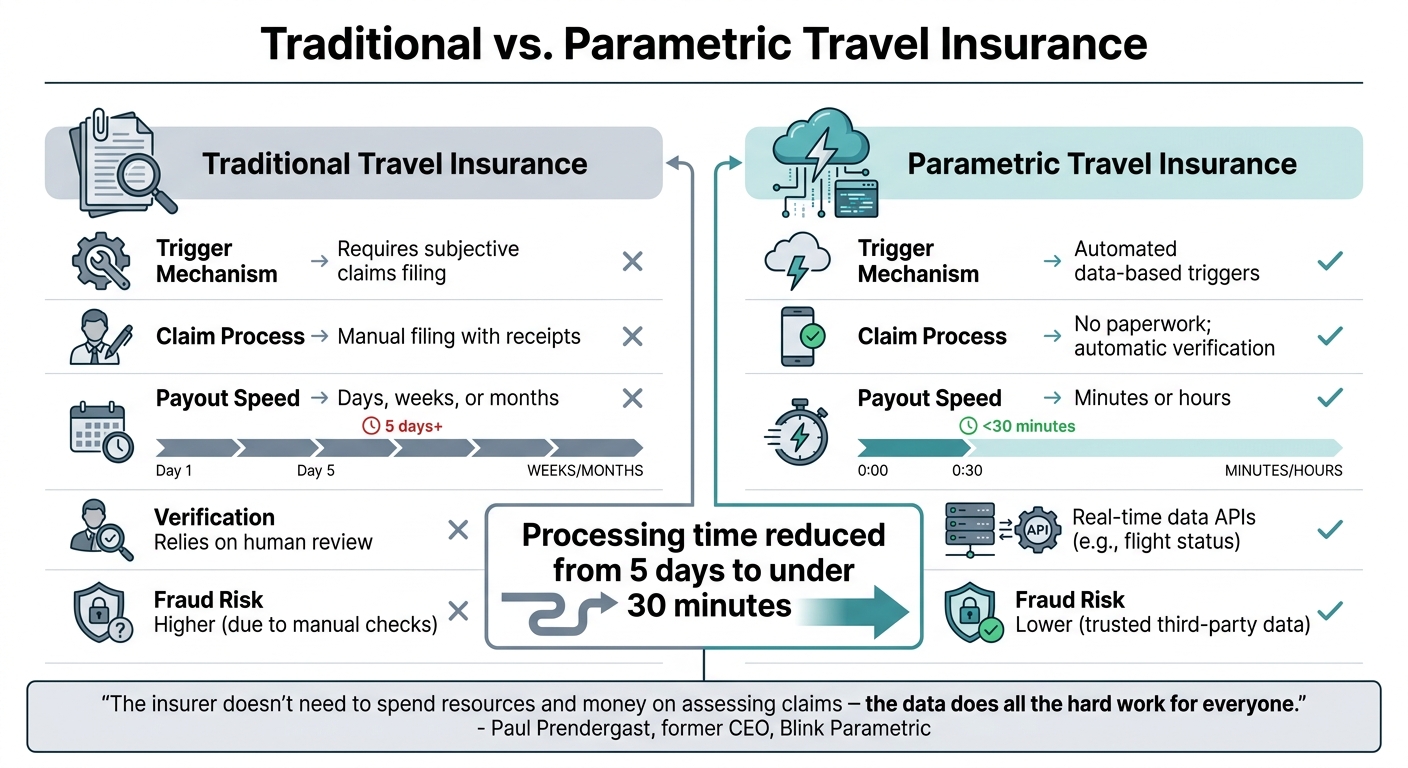
Parametric insurance takes a completely different approach to claims, removing the need for manual processes. Instead of requiring travelers to submit forms and wait weeks for reimbursement, it uses objective data to trigger automatic payouts when specific, measurable conditions are met.
The concept is simple: when a pre-defined event happens, the payout is triggered automatically. Take travel insurance, for example - a flight delay of more than 2 hours could result in an instant payment, no paperwork required. This is made possible by integrating reliable third-party data sources, like aviation APIs, to confirm the event in real time [10].
In June 2025, an insurer in the Asia-Pacific region partnered with VariFlight's real-time flight status API to streamline delay claims. By setting a 2-hour delay as the trigger, they reduced claim processing time from 5 days to less than 30 minutes. This not only sped up resolutions but also significantly improved customer satisfaction [10]. The process was straightforward: the insurer connected to the API, defined the event threshold, and let the system handle verification and payouts automatically.
"The insurer doesn't need to spend resources and money on assessing claims – the data does all the hard work for everyone."
This system is a game-changer compared to traditional methods, as shown below.
Here's how traditional and parametric insurance stack up when it comes to claims management:
Feature
Traditional Travel Insurance
Parametric Travel Insurance
Requires subjective claims filing
Automated data-based triggers
Manual filing with receipts
No paperwork; automatic verification
Takes days, weeks, or months
Happens in minutes or hours
Relies on human review
Uses real-time data APIs (e.g., flight status)
Higher, due to manual checks
Lower, thanks to trusted third-party data
Traditional insurance makes travelers prove their loss and wait for human review, while parametric models rely on real-time data to handle verification instantly [12]. This contrast highlights the importance of automation in modern claims processing.
Real-time claims processing provides immediate financial relief. Imagine your flight is delayed by 3 hours - you might need money right away for a hotel or a meal. Parametric systems ensure payouts or services are delivered exactly when they're needed.
For insurers, automation also means lower operational costs. It allows them to manage high claim volumes during widespread disruptions without hiring extra staff. For example, a European digital insurer saw a 12% profit increase after using historical flight delay data to create dynamic pricing models. These models adjusted premiums based on route reliability, charging more for risky routes and less for dependable ones [10].
"Parametric insurance offers speed and certainty, as it is based on data, parameters, and pre-defined triggering events. The key is the lack of moral ambiguity."
Beyond payouts, this system enhances proactive service. Travelers can be notified of disruptions and compensated before airlines even announce delays. What could have been a frustrating experience becomes an opportunity for insurers to provide immediate, meaningful support. In today’s world, where travel disruptions are all too common, quick payouts aren’t just helpful - they’re essential.
Including insurance during the booking process makes a lot of sense - it’s when the risks of travel are fresh in the customer’s mind. By embedding insurance directly into the booking flow, coverage can be tailored to each trip, addressing gaps in the market and replacing outdated, standalone policies that don’t align with today’s travel needs. Thanks to API-driven integration, adding insurance becomes effortless - no extra steps or forms required.
This approach tackles a major frustration for customers. As Ernesto Suarez, Founder of Gigasure, puts it:
"A customer's worst nightmare is to continually be handed off to the next provider"
.
When insurance is embedded, everything happens in one place. This creates a smoother process, improves the customer experience, and boosts conversion rates. Plus, it simplifies decision-making and ensures immediate support during unexpected travel disruptions.
APIs play a key role by providing real-time insurance quotes and enabling instant purchases. This aligns perfectly with the mobile-first habits of today’s travelers. Automated rule sets for pre-underwriting streamline product design and speed up policy issuance. By directly connecting to booking platforms, APIs deliver instant, trip-specific coverage options without redirects or delays, making the process seamless and user-friendly.
Walnut Insurance offers several integration solutions to match different technical needs. Here’s a breakdown:
These options let travel platforms choose the right level of integration based on their resources and customer objectives, ensuring flexibility without compromising on user experience.
Walnut Insurance is tackling long-standing issues in the travel insurance industry with a platform designed for modern challenges. By using parametric models, Walnut ensures automatic, real-time payouts for specific events like flight delays over 90 minutes. This approach slashes claim processing time from an average of 5 days to under 30 minutes [10].
The platform's API-first integration connects directly with travel booking systems, allowing instant policy creation and coverage binding in seconds. This seamless connection ensures travelers are covered without any extra hassle. As Ernesto Suarez, Founder of Gigasure, puts it:
"If I have to a claim, I want somebody to be in touch with me right away. I don't want to receive an email that says, 'You'll hear back from us in 5 days.' That's a lifetime for a customer."
By automating claims and accelerating payouts, Walnut not only improves customer satisfaction but also boosts operational efficiency for businesses.
Walnut's platform goes beyond simply filling coverage gaps; it opens up new revenue opportunities for travel companies. Businesses earn insurance commissions, while risk-based pricing - using historical delay data - can increase profits by 12% [10]. Dynamic pricing further allows businesses to adjust premiums based on route reliability, maximizing profitability.
Faster claims processing also builds trust, which is crucial in the competitive travel industry. By combining superior customer experiences with revenue potential, Walnut positions embedded insurance as a strategic advantage rather than a secondary offering.
Walnut’s platform also stands out for its technical adaptability and compliance support. With access to more than 14 insurance carriers and adherence to strict data privacy and security standards [14] [16], Walnut ensures businesses remain compliant across markets.
The platform offers three integration options:
These options allow businesses to choose the best fit based on their technical capabilities and resources. This modular design caters to companies of all sizes, from startups to established enterprises, without requiring extensive infrastructure. Additionally, the flexibility enables businesses to provide tailored coverage based on travelers' unique patterns while maintaining compliance [14] [15].
Travel disruptions have become a regular part of life, yet many insurance policies still operate as if delays and cancellations are rare occurrences. This outdated approach leaves travelers navigating frustrating processes, with "named perils" policies and extensive documentation causing payout delays that can stretch for days or even weeks [1][4].
For travelers stuck at airports or facing unexpected hotel stays, immediate financial support is crucial - not something that should hinge on a drawn-out review. This is where parametric insurance and embedded solutions step in. By leveraging objective data triggers, these modern options can automate payouts in under 30 minutes [10]. Embedding insurance directly into the customer journey ensures coverage is clear, relevant, and free from confusing fine print.
The consequences of failing to adapt go beyond customer dissatisfaction. For travel companies and insurers, sticking to outdated practices can also harm employee morale and retention [3]. To meet the needs of today’s travelers, rethinking and updating product designs isn’t just a good idea - it’s a necessity.
Parametric triggers and embedded insurance solutions aren’t just innovations; they’re exactly what travelers and the market are calling for.
Parametric travel insurance offers a streamlined approach for travelers by providing automatic payouts when certain pre-defined events happen - like a flight delay lasting longer than a specified period. Unlike traditional insurance, which often involves lengthy claims processes, this type of coverage relies on objective data to determine eligibility. This means travelers can receive payouts faster and with less hassle.
Legacy travel insurance policies often miss covering disruptions beyond the usual delays and cancellations. Events like natural disasters, geopolitical threats, and social unrest - all increasingly common - are typically excluded. With the changing travel landscape, these gaps emphasize the importance of updating insurance solutions to address modern-day challenges effectively.
Embedded insurance weaves coverage directly into the travel booking process, making it easy for travelers to add insurance when reserving flights, hotels, or other arrangements. This approach relies on a digital-first model, leveraging real-time data to offer flexible features like parametric delay triggers and instant claims processing. By integrating insurance at the point of booking, it creates a smooth, personalized experience - perfect for today’s travelers who often deal with delays and disruptions.