
April 13, 2026
Most Canadians with short-term disability (STD) coverage don't realize they have it, leaving them financially vulnerable during health-related work absences. Here's what you need to know:
Employers and insurance providers must simplify access and improve education to ensure Canadians can rely on STD benefits when they need them most.

Short-term disability (STD) coverage exists, yet many Canadians don't take advantage of it. The reasons? Poor communication, confusion about available programs, and a complicated claims process.
Employers often fail to clearly explain the benefits they offer. Details about STD coverage are usually buried in lengthy booklets or briefly mentioned during onboarding, leaving employees unsure about what’s available or how to access it.
Among Canadians with employer-provided benefits, 24% admit they don't know much about their coverage, and only 5% turn to their benefits as a go-to resource for well-being support. Additionally, 17% are unsure where to start, and 15% feel they lack helpful resources [4].
"Employers should look to improve communication around benefits, work with their benefits provider to offer more personalized solutions, and make it easier for employees to access the support they need, when they need it."
– Andrejka Massicotte, Head of Group Benefits,
This lack of ongoing education means many employees are unaware that most group plans replace only 60% to 85% of gross income [6]. Unfortunately, this becomes clear only when they find themselves needing to file a claim.
Canada’s disability income system is a maze of overlapping programs, each with its own rules and definitions. Employees often mix up STD benefits with Employment Insurance (EI) sickness benefits, Workers' Compensation, or long-term disability (LTD) coverage.
One common misunderstanding is that government programs provide full income replacement. In reality:
To complicate matters further, employees generally can’t receive EI sickness benefits and STD benefits at the same time. If an STD claim is delayed, EI may act as a temporary option, but once STD is approved, any EI payments must be reported [3].
Canada’s seven different disability income schemes create a confusing and burdensome system. This complexity discourages many from filing claims, adding to the challenges employees face when seeking support.
Even when employees know about their STD benefits, the claims process itself can feel daunting. Waiting periods often mean workers need to use sick days or vacation time before benefits kick in.
The paperwork adds another layer of difficulty. Insurers frequently request additional medical documents, causing delays. To keep receiving benefits, claimants must stay under active medical care and regularly submit updates from their doctor [3].
These hurdles can create distrust in the system. As a result, many employees prioritize other expenses over income protection. For those already dealing with an illness or injury, navigating these obstacles can feel overwhelming, leading some to avoid filing claims entirely. These challenges highlight the need for simpler, more accessible solutions to ensure income protection is within reach for those who need it most.
Short-term income loss is a reality for more Canadians than many might realize. While understanding the barriers to short-term disability (STD) claims is important, grasping the financial toll of temporary income loss is equally critical. These disruptions can have a profound impact, underscoring why income protection during absences is so important.
The primary drivers of short-term income loss in Canada are personal illness and disability. About 3.7% of employees experience absences lasting two weeks or more due to personal illness or disability, while 1.4% are affected by work-related injuries or illnesses. On average, these absences last 11 weeks - with 13 weeks for work-related cases and 10 weeks for personal causes. Notably, 30% of work-related cases and 20% of personal cases extend to 17 weeks or longer [8].
Common reasons for these absences include cognitive challenges, chronic pain, recovery from surgery, digestive issues, and mobility limitations [2].
Even a short-term loss of income can create significant financial strain. For instance, 76% of workers believe that a three-month work absence would severely impact their finances. Over half of workers say they would struggle with just a one-week delay in pay, and nearly one-third would deplete their savings within six months after a major health issue [5][9][11].
When income stops for weeks or months, people often turn to personal savings, a spouse's income, or liquidating investments to cover basic expenses [9]. Alarmingly, 26% of Canadians report they couldn’t raise $2,000 within a month for an emergency [9].
"A long term disability can have serious consequences affecting one's financial situation, including leaving insufficient funds to cover regular living expenses and/or delaying or reducing retirement savings."
– Mark Hardy, Senior Manager, Life and Living Benefits, RBC Insurance
The situation is worsened by limited access to paid sick leave. As of 2023, only 64% of Canadian employees have access to paid sick leave through their employers [7]. Part-time workers are particularly vulnerable, with just 23.3% having access compared to 72.2% of full-time workers [7]. For those without employer-sponsored protection, there’s often a two-week unpaid waiting period before Employment Insurance (EI) sickness benefits kick in [8].
Short-term disability benefits are designed to address these exact income gaps. Typically, STD plans cover absences lasting 15 weeks to six months, aligning closely with the 11-week average disruption. With waiting periods as short as one to seven days, these plans provide timely support, replacing 50% to 100% of earnings. In contrast, long-term disability benefits only begin after 90 to 180 days and replace 60% to 85% of income [12].
For workers relying on Employment Insurance, the maximum weekly benefit for 2026 is $729, which amounts to just 55% of the yearly maximum insurable earnings of $68,900 [10]. This often falls short of the coverage provided by private STD plans.
The close alignment of STD benefits with income disruption timelines makes them a vital safety net. However, many Canadians remain unaware of these benefits or how to access them. Raising awareness and exploring more integrated income protection solutions is essential to ensuring workers have the support they need during temporary absences. STD benefits play a crucial role in bridging financial gaps, paving the way for discussions on how embedded insurance can address existing coverage gaps.
Short-term disability plans in Canada often fall short, leaving many workers exposed. A staggering 26% of working Canadians don’t know if they even have disability benefits. For those who do, the coverage frequently excludes key income sources like bonuses and commissions. This results in an actual take-home replacement rate of just 35% to 50%, far below the promised 60% to 70% [4][13]. Embedded insurance offers a solution by integrating income protection directly into everyday financial systems, addressing these gaps with a more seamless approach.
Embedded income protection works by integrating directly into payroll systems, fintech apps, and lending platforms. Using AI-powered tools, these solutions map data fields and create API connectors to operate smoothly in the background [14]. Gone are the days of filling out paperwork or undergoing medical exams - automated underwriting uses platform data to provide coverage instantly. When a qualifying event occurs, AI processes claims in real time, ensuring immediate financial support.
This approach makes income protection more accessible and visible, meeting people where they already manage their finances or receive their paychecks. It’s about simplifying access to protection when it’s needed most.
Embedded income protection removes many of the hurdles associated with traditional short-term disability (STD) plans. Businesses, for example, can implement these solutions in just days, thanks to sandbox environments that allow API testing before deployment [14]. The underwriting process is streamlined, often requiring no medical evidence, and claims are processed automatically with built-in fraud detection.
A major advantage is the ability to cover income components that traditional group plans often exclude. Employer-sponsored plans typically protect only base salaries, but embedded options can include bonuses, commissions, and other variable earnings [13][14]. For the 52% of Canadians or their spouses managing a mental or physical health condition, this broader coverage can mean the difference between financial stability and hardship [4].
Here’s a comparison of how embedded income protection stacks up against traditional group STD plans:
Feature
Traditional Group STD Plans
Embedded Income Protection
Manual enrollment; separate from financial tools
API-driven; integrated into payroll/banking apps
Often requires medical evidence for higher limits
Automated underwriting via platform data
Manual filing and documentation
Real-time AI processing; often paperwork-free
Usually base salary only
Can be tailored to total platform earnings
Can take weeks for setup and approval
Implemented within days
Embedded solutions offer a practical alternative to traditional STD plans, particularly for small and medium-sized businesses (SMBs), which make up over 99% of Canadian companies. These solutions simplify the process, eliminating the need for complex HR management while still offering competitive income protection [15].
For workers with variable income, embedded insurance addresses a critical gap. By linking coverage to actual platform earnings instead of just base salaries, these solutions can achieve the 60% to 85% income replacement target for everyone - not just salaried employees [1][13]. Additionally, because premiums can be paid with after-tax dollars through payroll systems, benefits are often tax-free, resulting in a higher net income replacement compared to employer-paid plans where benefits are taxable [1][13].
This shift toward embedded insurance aligns with a growing expectation among Canadians for protection to be seamlessly integrated into their financial lives [14]. With disability rates rising by 5 percentage points between 2017 and 2022, the demand for accessible and comprehensive income protection has never been more pressing [6]. The next step is to explore how specific platforms are adopting these solutions to better serve Canadian workers and businesses.
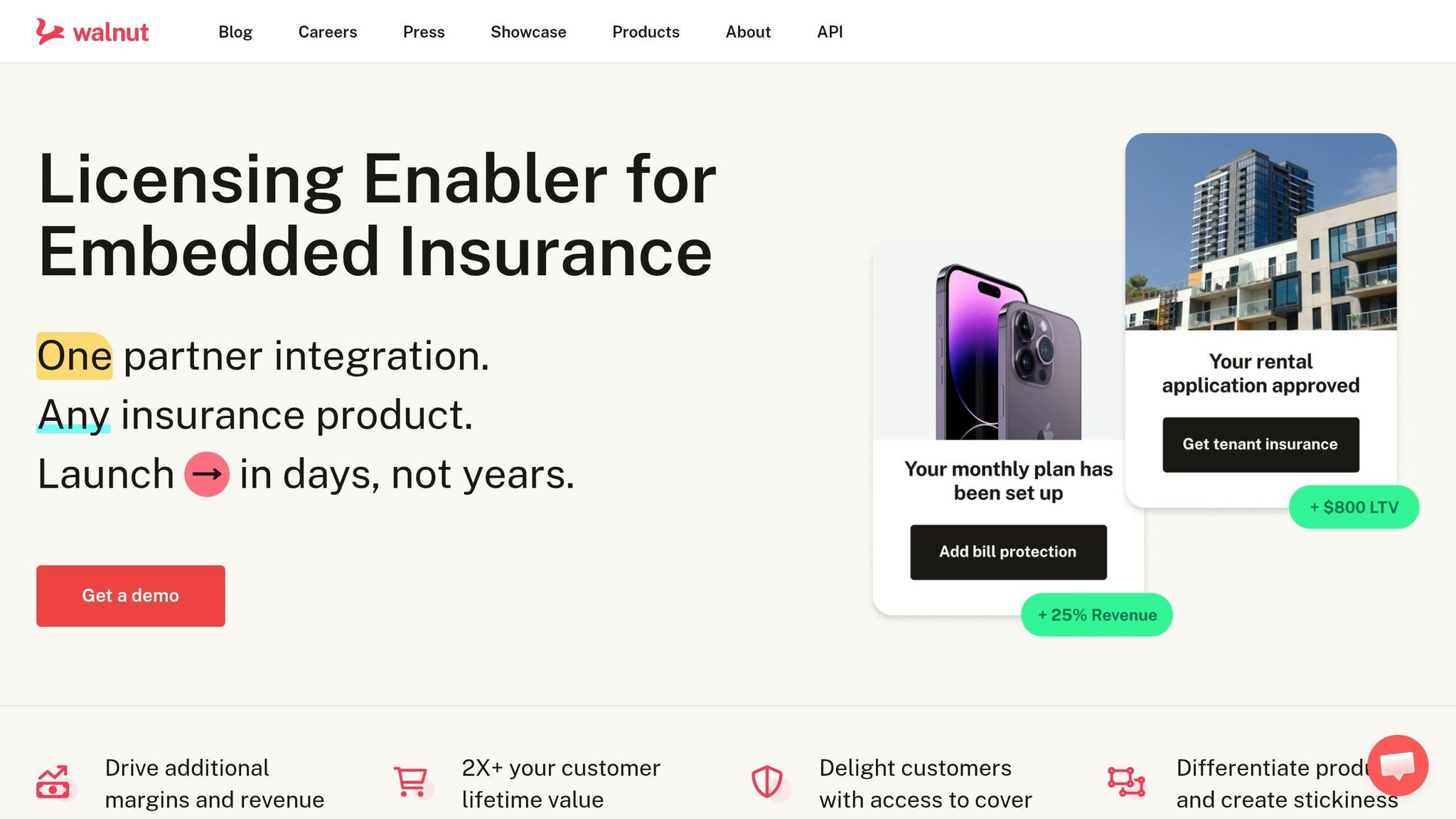
Walnut Insurance has stepped up to address the gaps in traditional short-term disability (STD) coverage by embedding income protection directly into digital financial systems. This approach simplifies the process for businesses and their customers by integrating insurance where people already manage their finances or receive paychecks. By doing so, Walnut tackles both the lack of awareness and insufficient coverage in the disability insurance space. This solution is an example of how embedded insurance can reshape the Canadian market by addressing long-standing challenges.
Walnut's integration model is designed with flexibility in mind, offering businesses three levels of implementation through its "Crawl, Walk, Run" approach:
This phased approach means companies can roll out branded insurance programs quickly - sometimes in just days - without the long lead times typically associated with insurance offering.
Walnut's platform allows businesses to stand out in a market where disability insurance is often overlooked, even though many recognize its importance. By embedding income protection, businesses can offer coverage for key events like involuntary job loss, disabilities caused by chronic illness or mental health issues, and critical illnesses. These offerings align with short-term income disruptions and help meet customer needs.
This integration not only improves customer retention but also doubles lifetime value [16]. With over 50% of consumers showing interest in such offerings [17][18], businesses can attract a broader audience. Walnut also provides a dashboard for real-time tracking of customer enrollment and protection status, enabling businesses to monitor their impact and fine-tune their offerings as necessary.
Short-term disability (STD) benefits can only provide real protection if employees are aware of them and understand how they work. The challenge goes beyond coverage - poor communication often leaves employees unprepared for health setbacks.
Here's a stark reality: while 31% of Canadians see disability insurance as important, only 10% are covered. Even more concerning, 33% say their savings would run out within six months of a serious illness[11]. Traditional benefits programs often fail because they rely on employees seeking out information during a crisis - precisely when navigating complex claims processes feels overwhelming.
To address these issues, new approaches are needed. Embedded insurance offers a way forward by integrating income protection directly into platforms employees already use to manage their finances. This makes benefits easier to access, bypassing the obstacles of busy schedules, confusion, and low engagement that prevent many Canadians from using their benefits[4]. Digital integration ensures that insurance is available when it’s needed most.
For employers, offering embedded income protection does more than close the coverage gap - it demonstrates a commitment to employee financial health. By simplifying access, embedded insurance connects the dots between benefit availability and employee awareness, providing a stronger safety net for Canadians during tough times.
To determine if you have short-term disability coverage, start by reviewing your benefits package or employee handbook - these documents typically include details about your coverage. You can also log into your benefits portal or check your pay stubs, as coverage information might be listed there. If you're still uncertain, your best bet is to contact your HR department or benefits administrator directly. They can provide clear answers and specifics about your plan.
Yes, it's possible to receive both EI sickness benefits and short-term disability (STD) payments simultaneously. However, the exact amount you receive might be adjusted depending on how your specific plan is structured. To understand how these benefits work together, review the terms of your plan carefully.
To file a short-term disability (STD) claim, you'll usually need a few key documents:
It's always a good idea to confirm the exact requirements with your insurer or plan administrator, as they may ask for additional paperwork depending on your situation.