
June 22, 2026
Rent is the largest expense for 35% of American households, yet most financial protections fail to address it. Missing rent can lead to late fees, credit damage, or eviction, but renters rarely have safeguards against these risks. While homeowners can pause mortgage payments during hardships, renters have no comparable safety net. Current insurance products, like renters insurance, don’t cover missed rent, leaving a gap in financial protection.
Key Points:
Solution: Embedded rent protection, integrated into rental platforms, offers a new way to safeguard renters by covering missed payments due to life events like job loss or illness. This approach simplifies access, reduces renter churn, and protects landlords’ income.
Rent protection is a critical need, and embedded solutions aim to close this gap efficiently.
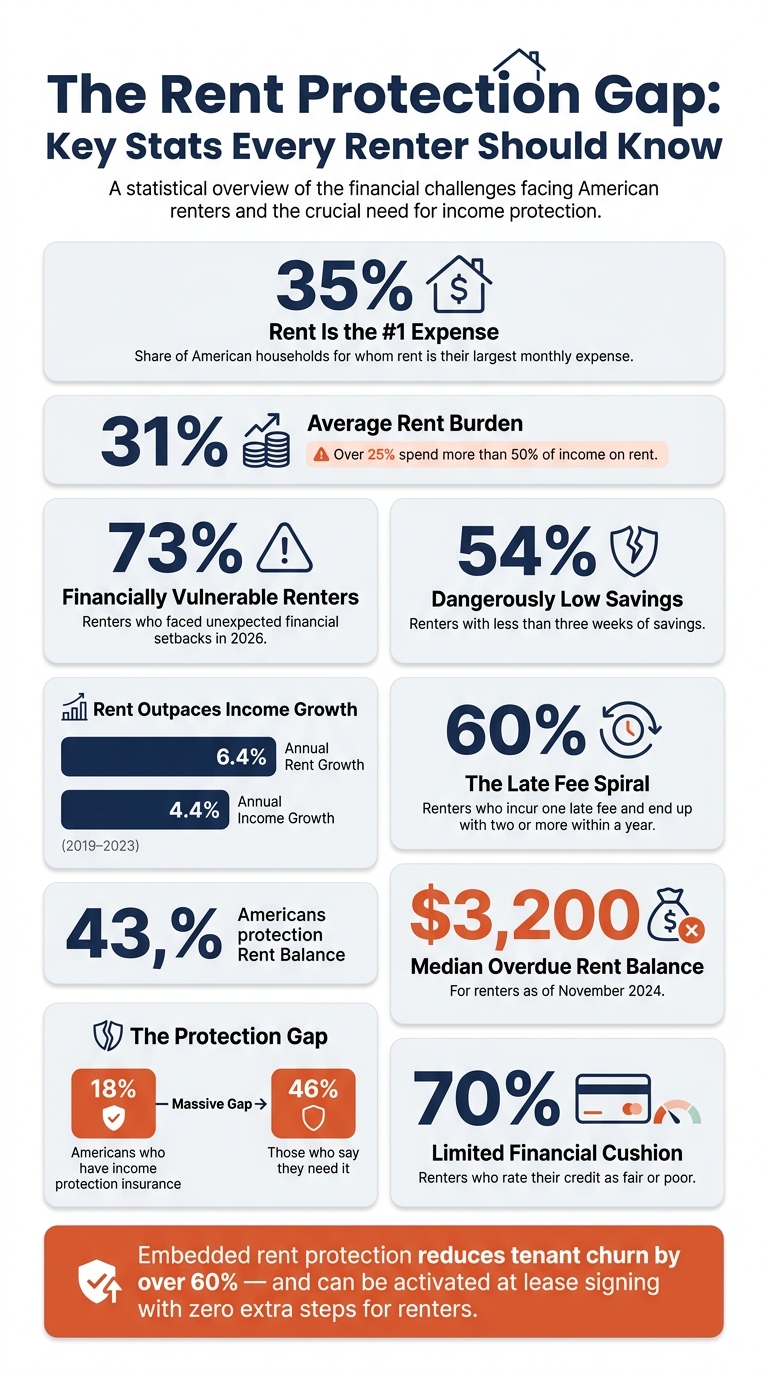
Rent is often the biggest monthly expense for renters, and missing a payment can lead to eviction - a far more severe consequence than a late credit card fee.
For many households, rent is a financial strain. On average, renter households dedicate 31% of their income to rent [5], and over a quarter of them spend more than half their income just to keep a roof over their heads [4]. Between 2019 and 2023, median rent rose by 6.4% annually, outpacing the 4.4% annual income growth during the same period [4]. This growing gap leaves renters struggling to keep up.
An often-overlooked challenge is the mismatch between when rent is due and when renters get paid. Ryan Metcalf, VP of Public Affairs at Flex, explains:
"When rent is due on the first and you are paid biweekly or have variable income, rent can take up to your entire paycheck leaving little to nothing left to pay other expected or unexpected essential bills before the next paycheck. That's a structural problem."
This timing issue means that even renters who manage to pay on time are often living paycheck to paycheck. For those who fall behind, the situation can quickly spiral. Nearly 60% of renters who incur one late fee end up with two or more within a year, and by November 2024, the median overdue balance for renters reached $3,200 [1]. Adding to this, 70% of renters rate their credit as fair or poor [3], highlighting how little financial margin they have to absorb unexpected expenses.
These factors reveal why current protections often fail to meet renters' needs.
Despite these challenges, renters face limited safety nets, especially compared to homeowners. Homeowners with government-backed mortgages through programs like Fannie Mae or Freddie Mac can often pause payments with minimal hassle. Renters, on the other hand, have no comparable option. While emergency rental assistance programs exist, they are fragmented, vary by location, and typically require extensive paperwork. Worse, they can take weeks to deliver aid [4].
Renters insurance doesn’t help either - it covers personal belongings and liability but not rent payments. Landlord insurance may protect property owners’ income in certain cases, but it offers no relief to struggling tenants. This leaves renters exposed. Only 18% of Americans carry income protection insurance, despite 46% saying they need it [6]. For renters - who are already more financially vulnerable than homeowners - this gap can have serious consequences. The lack of direct, efficient solutions underscores the urgency of addressing renters' financial risks more effectively.
Building rent payment protection has faced several obstacles, primarily stemming from regulatory hurdles, challenges in risk modeling, and distribution inefficiencies.
The regulatory environment for rent protection is a maze of state and federal laws. Products designed to guarantee rent payments or cover a tenant’s inability to pay can resemble insurance in the eyes of regulators, even when they’re structured differently. Steven Barge-Siever, Esq. of Upward Risk Management highlights this issue:
"At scale, rent guarantees begin to resemble unlicensed insurance operations."
States like California, New York, and New Jersey are especially vigilant, closely examining any product that underwrites tenant performance without proper insurance licensing or sufficient capital reserves. To navigate this, some platforms rely on structures like a Contractual Liability Insurance Policy (CLIP), which shifts obligations into a licensed insurance framework. Without such measures, these platforms risk regulatory action.
On a federal level, laws like the Truth in Lending Act (TILA) add another layer of complexity for rent-related financial products. For instance, some "Rent Now, Pay Later" programs have faced scrutiny for charging interest rates exceeding 180% on certain loans [5]. These regulatory challenges only add to the difficulty of creating compliant and sustainable solutions.
Pricing rent protection risk is no simple task. Unlike rare, isolated events like car accidents or house fires, rent delinquency often happens in clusters. Economic downturns can lead to widespread renter defaults, making traditional risk-pooling models ineffective.
Behavioral data further complicates this. About 42% of renters who miss one payment go on to miss the next, and 30% remain behind five months later [1]. This isn’t just a one-time issue; it’s a persistent cycle that’s tough to quantify as a standard insurable event. Adding to the complexity, delinquency rates have fluctuated significantly - from a peak of 23% in early 2023 to 14% by late 2024 [1]. This volatility makes it difficult to design stable, long-term pricing models.
Even with compliant designs and refined pricing models, distribution poses another major challenge. Traditional channels are too costly for low-premium products. When customer acquisition costs are high, and monthly premiums are small, the math simply doesn’t work.
There’s also a deeper issue: a mismatch in incentives. Property managers have typically treated missed payments as an unavoidable cost of doing business, rather than a problem that can be solved. Insurers, on the other hand, haven’t had a natural way to integrate into the rental process. This leaves renters - the group most in need of protection - without options at the exact moment they’re most likely to want help. As Hanif Joshaghani, CEO and Co-Founder of Symend, puts it:
"Every enterprise that bills a consumer every month... is watching the same movie play out: customers hit a life event, miss a payment, and churn. We've collectively accepted that as the cost of doing business. It isn't. It's a failure of product design."
The table below outlines how these misalignments affect key stakeholders:
Stakeholder
Traditional Gap
What's Missing
High-friction, standalone products offered at the wrong time
Affordable, timely protection embedded in the rental experience
Missed payments treated as unavoidable write-offs
Tools to reduce defaults and recover revenue
High acquisition costs; limited data for underwriting
Real-time transaction data and low-cost embedded distribution
These combined challenges - regulatory, actuarial, and distributional - explain why rent protection solutions have struggled to gain traction, despite the growing demand. Overcoming these barriers is key to creating embedded products that offer immediate and meaningful protection for renters.
Embedded rent protection is addressing a long-standing gap by tackling risks right at the point of payment. While challenges in regulation, actuarial modeling, and distribution remain, this approach brings protection directly into the space where tenants manage their rentals.
The concept is simple: instead of offering rent protection as a standalone product through separate channels, it's seamlessly integrated into the lease-signing or rent-payment process. For example, when a renter uses a property management app to sign a lease, the coverage activates as part of reviewing the lease terms. It’s all built into the workflow, making it part of the natural rental process.
This timing is key. Embedded solutions engage more renters, especially those who’ve been underserved. While only 18% of Americans currently have income protection, nearly half (46%) believe they need it [2]. By eliminating the need for research, comparison shopping, or separate enrollment, these solutions make protection more accessible. The smooth experience is powered by advanced API integrations that handle the heavy lifting behind the scenes.
APIs are the backbone of embedded rent protection, connecting rental platforms with insurance providers. Through a single API, platforms can access up to 14 insurance carriers, enabling real-time quotes, instant policy binding, and automated claims processing [8].
This creates what’s known as "invisible insurance" - coverage that activates automatically based on key actions like signing a lease or making a rent payment. Renters don’t need to fill out additional forms, as authentication and integration are handled seamlessly through standard API protocols.
The level of integration depends on a platform's technical capabilities:
Integration Option
Technical Requirement
Customization Level
Launch Speed
Data Integration
No-code
Low
Days to Weeks
Minimal data sharing
Low-code
Medium
Days
Pre-filled customer data
High (Developer required)
Full (Native UI/UX)
Weeks
Full data integration & automation
Platforms that bundle insurance premiums with rent payments via the same ACH rail can also achieve significant cost savings - reducing processing expenses by over 1,000% [8]. This efficiency is particularly valuable for platforms managing large transaction volumes.
Thanks to API-driven integration, rent protection products are designed to address specific risks tied to rent payments. Coverage typically focuses on qualifying life events like job loss, hospitalization, critical illness, or death, rather than offering broad coverage for any missed payment. When a covered event occurs, the service pays the rent directly to the landlord, ensuring the account stays current and avoiding further complications [2].
Policies are usually limited to a specific period, such as two to three months of rent. This provides renters with a meaningful safety net while keeping costs predictable for insurers. It also helps address the challenges of modeling rent-related risks, which have historically been tricky due to clustering issues.
By paying landlords directly, these products reduce the risk of funds being misused, giving landlords confidence in their rental income and minimizing moral hazard for insurers.
Adrien Niblock, Co-Founder of Walnut Insurance, highlighted the significance of this shift:
"Embedded insurance has been promised for years. SymendPrevent is what it looks like when it actually works at scale. This partnership isn't incremental. It's a structural shift in who gets to participate in financial protection, and who gets to deliver it."
Embedded rent protection doesn’t just safeguard renters - it also benefits property managers by reducing churn by over 60%, helping maintain occupancy and ensuring renters stay housed [2].
To successfully integrate embedded rent protection, platforms must first establish accurate, real-time data pipelines. These pipelines should collect critical information like rent amounts, lease terms (start and end dates), payment history, and basic tenant identity verification. This data plays a vital role in the underwriting process, enabling more precise risk assessments by moving away from static averages.
Compliance can feel complex, but working with a provider that offers full-service licensing and broker support can simplify the process. The NAIC's model AI bulletin, already adopted in 23 states and Washington, D.C., is helping create clearer standards for using AI-driven data in underwriting.
"Data is at the core of any insurance offering, empowering insurers to understand the unique needs and risk profiles of underserved segments and helping to create better risk assessment, pricing, and distribution models." - CGAP Research & Publications
With strong data systems and a clear compliance framework in place, platforms can then focus on choosing the right integration method.
Selecting the right integration method depends on a platform's technical resources and the desired user experience. Options include Co-Branded Link Out, Data-Driven Referral, or Headless API - each offering a different balance of customization, complexity, and speed to market.
One effective strategy is pre-filling tenant data during lease signing. This approach minimizes adverse selection by keeping the risk pool broad and balanced.
Once the integration is live, it’s essential to track its impact on all stakeholders. Key metrics for platform operators include Average Revenue Per User (ARPU), customer lifetime value, and churn rates. Landlords benefit from fewer payment defaults, lower collection costs, and more predictable loss curves. For tenants, the process is seamless - one-click coverage at lease signing signals that the system is functioning as intended.
Embedded insurance is poised for rapid growth, with strong support from insurers. For rental platforms, the benefits are clear: fewer defaults, reduced churn, and an additional revenue stream. Even better, the customer acquisition cost (CAC) is projected to be just $22 to $42, a fraction of the $300 to $1,280 typically spent through traditional channels.
Renters face a unique challenge: their biggest expense - rent - often goes unprotected. Traditional insurance products weren’t designed to address rent, and hurdles like regulation, actuarial modeling, and distribution have historically left this financial gap wide open. Embedded solutions, however, offer a way to bridge this gap effectively.
By incorporating rent protection directly into lease agreements and payment processes, coverage is activated when tenants need it most - without requiring them to take extra steps. Early results are promising, showing over a 60% reduction in tenant churn and open rates exceeding 50% when protection is presented at key moments [9].
This approach doesn’t just help tenants; it also reshapes the economics of property management. For landlords and rental platforms, the benefits include fewer defaults, reduced collection costs, and the creation of additional revenue streams. Improved tenant stability also encourages rental platforms to adopt these solutions seamlessly.
Platforms like Walnut Insurance make this process straightforward. With tools ranging from no-code integrations that can be set up in days to headless APIs with automated triggers and real-time data handling, they provide scalable, compliant rent protection solutions. Offering access to over 14 carriers and built-in compliance support, these platforms make implementing rent protection easier than ever.
Rent protection acts as a financial buffer, stepping in to cover unpaid rent when tenants face challenges like income loss or unexpected medical expenses. Typically, these policies cover anywhere from 1 to 6 months of missed rent payments. Some plans go a step further, offering coverage for additional expenses such as legal fees or property damage. This type of protection not only helps landlords keep their cash flow steady but also provides tenants with a layer of security during tough financial times, potentially avoiding the need for eviction.
Renters insurance doesn’t pay for your rent because its purpose is to safeguard your personal belongings and provide liability protection - not to cover your lease payments. These policies are limited to accidental "covered perils", such as fire or water damage. While some policies include loss-of-use coverage, which can help with temporary living expenses if your rental becomes uninhabitable, this coverage does not extend to unpaid rent, legal fees, or eviction costs. Those are classified as financial obligations, not insurable events.
Embedded rent protection works directly within the property management platforms you're already familiar with. It shows up at critical points, such as when a lease is signed or rent is paid, and activates automatically as part of the platform’s workflow. By relying on automated systems, it collects all the required information instantly, making the process seamless. This setup allows you to secure coverage quickly, often with instant quotes and activation completed in just a few minutes.