
June 19, 2026
Remote work has turned millions into digital nomads, but traditional travel insurance isn’t keeping up. Standard policies fail to cover long-term travelers who work abroad, leaving them exposed to financial risks like medical emergencies, equipment theft, or visa compliance issues. Here's what digital nomads actually need from insurance:
Traditional insurance models are outdated for a workforce that’s always on the move. Embedded solutions like Walnut provide tailored, location-aware coverage directly through apps and platforms digital nomads already use, solving these gaps effectively.
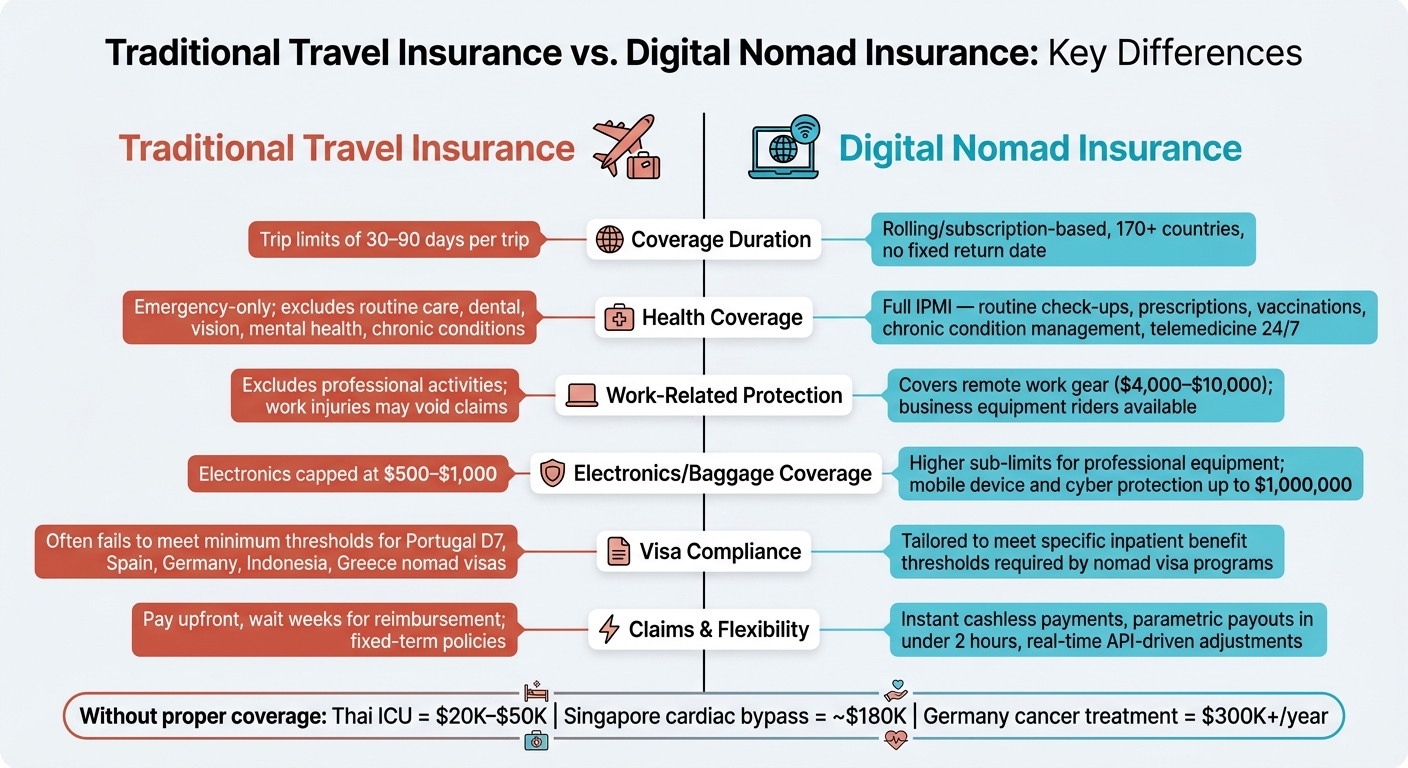
Most standard travel insurance policies are built with tourists in mind - people on vacation, not those actively working while traveling. This creates a major issue for digital nomads because these policies often exclude coverage for professional activities. If you get injured or sick while working remotely, your claim might not be covered [6][5].
The way insurers categorize travelers makes things even trickier. You're either labeled a tourist or a business traveler, leaving digital nomads in a murky middle ground. To make matters worse, if you're classified as a resident rather than a visitor, your policy could be voided entirely, regardless of your actual situation [6][1].
"As expats spend longer and longer periods of time abroad, traditional travel insurance will become irrelevant to them." - Doug Gulleson, Co-Owner, Good Neighbor Insurance
This coverage gap doesn’t just affect work-related incidents - it extends to essential health services while abroad.
Traditional travel insurance acts more like a safety net for emergencies rather than a full-fledged healthcare plan. Things like routine check-ups, vaccinations, dental care, vision care, and managing chronic conditions are often not included [7][2]. For digital nomads managing long-term health issues or even just needing a prescription refill, this can be a serious challenge.
Mental health coverage is another area where traditional policies fall short. Therapy and psychiatric support are usually excluded, even though long-term solo travel can take a significant mental toll. This is particularly concerning for older nomads, such as mid-career professionals or early retirees, who may also need more comprehensive chronic condition care [6][7].
The cancellation rules in standard travel insurance policies are another pain point. These policies are designed for people with fixed employers, steady salaries, and round-trip tickets. If you're a freelancer or self-employed and a client cancels a contract, your policy likely won’t cover the costs of canceled flights or accommodations [4].
Many annual multi-trip policies come with strict caps, limiting individual trips to 30 to 90 days [6][7]. For digital nomads who stay in one place for extended periods, this can mean coverage ends abruptly. On top of that, some policies treat even a brief visit to your home country as the end of your trip, potentially canceling or pausing your coverage for the rest of your travels [6][1].
These restrictions highlight the need for insurance options that are flexible and designed for the always-on-the-move lifestyle of digital nomads.
The financial risks of inadequate coverage can be staggering. Without proper insurance, digital nomads could face massive medical bills. For example:
And if you're relying on U.S. Medicare, you're out of luck - it won’t cover care received outside the United States [9].
There’s also the issue of compliance. Many countries, including Portugal, Spain, Germany, and Indonesia, require proof of health insurance that meets specific minimum coverage thresholds for digital nomad visas [8]. Standard travel insurance often doesn’t meet these requirements, leaving nomads vulnerable to financial risks and potential legal hurdles.
For digital nomads, the difference between standard travel insurance and what they truly need boils down to one key issue: emergency-only coverage versus full health coverage. What works for nomads is International Private Medical Insurance (IPMI) - plans that go beyond emergencies to include routine check-ups, vaccinations, prescription refills, and chronic condition management. Emergency medical evacuation is a must-have, but so is flexibility. Many IPMI plans offer worldwide coverage with a U.S. exclusion option, which can lower monthly premiums by 30–50% for those who don't plan to visit the U.S. [10]. Adding 24/7 telemedicine ensures minor health issues can be addressed before they escalate [2][12]. This kind of coverage aligns with the realities of a remote lifestyle.
Nomads also need policies designed with remote work in mind, especially when it comes to protecting their professional tools. A nomad's gear - laptop, phone, camera, and accessories - can easily range from $4,000 to $10,000 [5]. However, standard baggage coverage often caps electronics at $500 to $1,000, which barely covers a basic laptop. Policies offering business gear riders or higher sub-limits for professional equipment are crucial. As Doug Gulleson, Co-Owner of Good Neighbor Insurance, explains:
"Underwriters and brokers need to move beyond 'How do we cover a holiday?' to 'How do we provide adequate coverage for their lifestyle?'" - Doug Gulleson
Insurance for nomads also needs to adapt to their constantly changing travel schedules, which standard policies often fail to do.
Fixed-term policies just don't work for people who are always on the move. What fits their lifestyle better is subscription-style, rolling insurance - plans billed monthly or every 28 days, with no fixed return date and the ability to renew or purchase coverage while already abroad [2][13]. These plans should also include incidental home country coverage - usually up to 30 days per 90-day period - and allow for seamless portability across 170+ countries without requiring a new policy every time they cross a border [3][2][13].
"In nomad life, insurance is not there to make you feel free. It is there to make sure a bad week does not become a financially absurd one." - Matt Griffith, The Passport
Experienced nomads often use a layered approach to insurance: a base global health plan for ongoing medical needs, combined with add-ons for specific risks like adventure sports or high-value gear. This combination - comprehensive, work-friendly, and flexible coverage - addresses the unique challenges of a nomadic lifestyle [6][11].
To tackle the coverage gaps faced by digital nomads, embedded insurance weaves itself into platforms they already rely on. By integrating insurance options directly into booking tools, coliving apps, and coworking memberships, it eliminates the hassle of searching for separate coverage. This approach ensures that insurance is available right when it's needed and fits seamlessly into the user experience. Essentially, it becomes a natural part of the journey, designed specifically for the mobile lifestyle.
Doug Gulleson of Good Neighbor Insurance explains it perfectly:
"The modern customer often expects a world of cashless access, instant approvals, and seamless, invisible access in one place, such as an app."
The idea is for insurance to work quietly in the background, requiring minimal effort from the user - almost like it’s invisible.
Embedded insurance isn't just about convenience; it’s also about creating policies that align with the unique needs of digital nomads. Unlike traditional travel insurance, these policies cater to specific visa requirements and work habits. For example, plans can be tailored to meet mandatory health and repatriation coverage for visas like Portugal's D7, Spain's Digital Nomad Visa, or Greece's Digital Nomad Visa [2]. Additionally, coverage can adapt to remote work schedules, activating or pausing based on where and how the nomad is working.
Take Walnut’s embedded solution as an example. It offers instant payment for medical services, allowing nomads to pay on the spot without waiting for reimbursement. This eliminates the usual delays and financial stress that come with traditional claims processes.
The flexibility of these insurance solutions is powered by technology. APIs connect insurance systems to live data sources, such as flight trackers and travel itineraries. This means coverage can automatically adjust as a nomad’s plans change - no need to call a broker or buy a new policy every time they cross a border.
This connectivity also enables parametric payout models, where payments are triggered automatically by specific events like a confirmed flight delay. In these cases, claims are settled in under two hours, with funds sent directly to a digital wallet. For digital nomads who are always on the move, this speed and convenience are game-changing.
As Doug Gulleson puts it:
"Successful insurers will be those that bridge the gap between a low-cost, low-coverage travel plan and a high-cost, high-coverage comprehensive healthcare plan."
Walnut takes a simple but effective approach: it brings insurance directly to people, eliminating the need for them to search for it. Using its FlexTech™ technology, Walnut streamlines the entire insurance process - quoting, enrollment, billing, and contract management - through a single API or no-code integration [14]. This allows businesses to seamlessly embed insurance into their existing platforms without the hassle of overhauling their technology.
A great example of this is Walnut's partnership with Telus, one of Canada’s leading telecom providers. When Telus customers enter or leave a new country, they’re instantly prompted to secure travel insurance. The process is lightning-fast, taking less than 30 seconds, and has achieved a conversion rate of over 20% [14]. For digital nomads frequently crossing borders, this kind of effortless experience is invaluable. It also paves the way for more tailored and flexible coverage options.
Walnut offers a flexible suite of insurance products designed with remote workers in mind. This allows partner platforms to create custom bundles that cater to specific user needs. Coverage options include emergency medical care, trip cancellations, baggage protection, mobile device coverage, and even Personal Cyber Protection up to $1 million, complete with 24/7 support [15].
This flexibility is particularly useful for platforms serving professionals who work while traveling. For instance, a coworking membership app could provide users with a bundle that includes coverage for emergency medical needs abroad and protection against equipment theft - all without requiring users to leave the app. Neo Financial, which serves over 1 million customers, has successfully integrated Walnut’s multi-product insurance suite, offering everything from extended warranties to mobile phone protection [15].
Walnut doesn’t just provide coverage - it also helps platforms navigate the complex world of insurance regulations. Different countries have varying requirements, and many nomad visa programs - like Malaysia's DE Rantau or Thailand's LTR visa - demand specific inpatient benefit thresholds that standard travel insurance might not cover [10]. Walnut addresses these challenges with licensing support and broker assistance, enabling partner platforms to offer compliant coverage without needing their own insurance expertise [14].
The issue is clear: traditional travel insurance was designed with short vacations in mind, not a full-time, global lifestyle. Policies that exclude coverage for work-related activities, limit trips to 90 days, or fail to include routine medical care abroad simply don’t meet the needs of digital nomads.
This gap in coverage leaves digital nomads exposed to significant financial risks [2]. The outdated pay-and-claim model, where individuals must pay large sums upfront and then wait weeks for reimbursement, only adds to the frustration and undermines trust in the system.
"Our industry risks losing customers if we don't try to bridge the gap between treatment success and financial friction. Policies that cause financial gridlock will be failures in our customers' eyes." - Doug Gulleson, Co-Owner, Good Neighbor Insurance
This is where embedded, modular insurance is stepping in to transform the game. By addressing critical issues like coverage lapses during remote work and restrictions on trip durations, this new approach integrates insurance directly into platforms digital nomads already use - such as travel apps, coworking spaces, and telecom services. Instead of being an afterthought, insurance becomes a seamless part of their lifestyle. For businesses, this streamlined experience boosts customer loyalty and retention.
As the profile of digital nomads evolves, so do their insurance needs. Mid-career professionals and early retirees now represent a growing portion of long-term remote workers [1], bringing more complex demands. These individuals seek coverage that is continuous, cashless, visa-compliant, and presented with clear, upfront terms - solutions that foster trust and reliability.
Working remotely from another country can create serious issues with travel insurance. Many policies specifically exclude claims related to business activities, meaning if something happens while you're working, your claim might be denied.
Another common issue is the time limit on coverage. Most travel insurance plans only cover trips lasting between 30 and 90 days. If you're abroad for longer, your policy might expire without you realizing it.
There's also the risk of being considered a resident if you stay overseas for an extended period without notifying your insurer. In such cases, your travel insurance could be voided entirely. It's essential to understand these limitations if you're planning to work remotely while traveling.
Standard travel insurance typically focuses on short-term emergencies and won’t cover long-term health care overseas. It also excludes ongoing care or treatment for pre-existing conditions. For extended coverage, consider options like International Private Medical Insurance (IPMI) or a digital nomad health plan. These plans provide renewable, extensive coverage, including hospital stays, routine checkups, and even medical evacuation. When choosing a policy, aim for one with high annual limits (such as $1,000,000 or more) and ensure it complies with your host country’s visa requirements.
To keep your coverage intact while traveling between countries, opt for a digital nomad insurance plan tailored for ongoing, multi-country travel. These policies are designed to accommodate the unique needs of remote workers on the move, often with flexible, subscription-based options.