
October 31, 2026
Canada’s open banking framework is not a green light to use banking data for insurance. Start with one customer journey, check whether both data access and insurance use are lawful, and keep a fallback that works without bank data.
Here’s what that means for your plans:
A practical approach: use Walnut’s current distribution options for what they support today, treat banking-data features as a separate workstream, and check final rules before building around them. Start small: test one product and one journey, including what happens when customers <u>withdraw consent</u>.
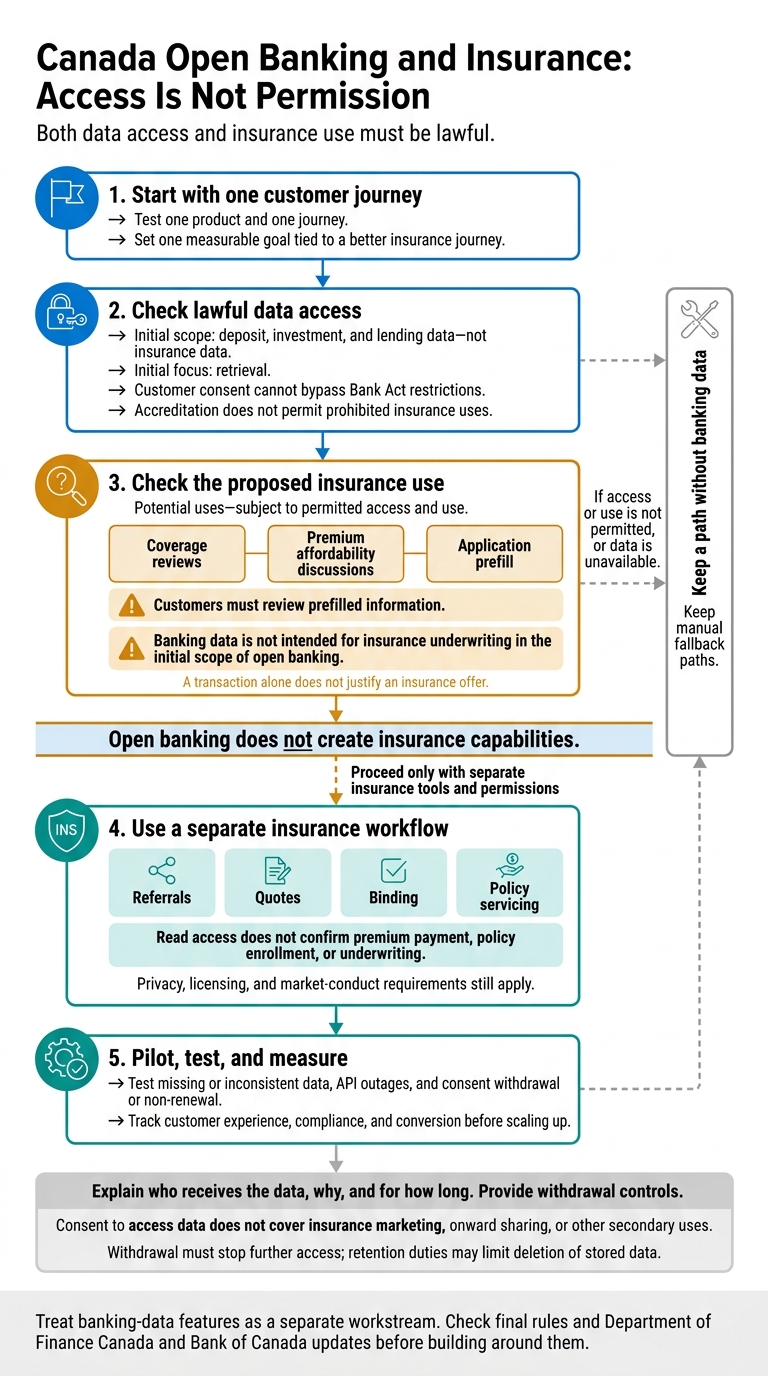
Canada Open Banking and Insurance: Access Is Not Permission
Within the framework’s limits, permissioned data could support a narrow set of customer-led insurance uses.
Under future rules, permissioned account, loan, and investment data could help identify financial commitments, guide premium affordability discussions, and prefill permitted fields.[1][2][6]
| Potential benefit | Limitation to address |
|---|---|
| More informed coverage reviews | Unlinked accounts can leave gaps in the financial picture. |
| Better premium affordability discussions | Misclassified transactions can distort cash-flow estimates. Ask customers to confirm them. |
| Less manual application entry | Withdrawn consent can break the data link during the policy term. |
| Smoother application preparation | Financial data does not replace claims, driving, or medical records. |
Customers must review prefilled information. Banking data is not intended for insurance underwriting in the initial scope of open banking.[6]
Banking events may point to an insurance need, but they do not create permission to sell insurance.
A new mortgage or auto loan could trigger a coverage review, and real-time balances and cash flow could support premium affordability discussions.[1][2]
These events should serve as invitations to a customer-led review. Any prompt, permitted prefill, or referral would still depend on consumer consent and the framework’s restrictions.[1][4][6] A transaction alone does not justify an insurance offer.[1][4]
Identifying a need is only the starting point. The next step requires a separate insurance workflow.
Separate insurance APIs already support referrals, quotes, binding, and policy servicing; open banking does not create these capabilities.[1][2] A referral connects the customer to an insurance provider. A quote presents proposed coverage and pricing, while binding puts coverage into effect.
Read access does not confirm premium payment, policy enrollment, or underwriting.[1][6] Those actions would require separate capabilities and permissions beyond the initial open banking rollout.
Access to data is only the first step. Compliance determines how a business can use it.
The Consumer-Driven Banking Act does not override Bank Act limits on sharing customer information with insurers, agents, or brokers for insurance activities.[1][7] Businesses must also follow federal and provincial privacy laws, licensing rules, and market-conduct requirements.[1][4] These rules matter when banking data is used to prefill forms, make referrals, or support servicing workflows.
Express consent should clearly explain who receives the data and why, without misleading language or pressure.[1][4] Consent to access data does not cover insurance marketing, onward sharing, or other secondary uses.[1][4]
Check these requirements before approving an integration. Using a provider does not remove the business’s compliance duties, including its licensed insurance obligations.[2] Each row connects a legal limit to a check your team can make.
| Requirement | Operational question | Insurance implication |
|---|---|---|
| ☐ Accreditation | Is the entity on the Bank of Canada registry? | Only accredited participants can receive data; accreditation does not permit prohibited insurance uses.[1][7] |
| ☐ Lawful access | Is the data flow permitted under banking law? | Customer consent cannot bypass Bank Act restrictions.[1][4] |
| ☐ Express consent | Are the recipient, purpose, data, accounts, and access duration clear? | Keep data-access permission separate from marketing permission.[1][4] |
| ☐ Purpose limits | Does actual use match the stated purpose? | Do not repurpose data for underwriting in the initial scope.[1][6] |
| ☐ Revocation | Can withdrawal stop further access? | Make sure customer controls stop the actual data flow.[1][4] |
| ☐ Audit logs | Are access, consent changes, and transfers recorded? | Keep records for audits and disputes.[1][4] |
| ☐ Cybersecurity | Do systems meet security and technical requirements? | Review receiving systems as well as the connection.[1][7] |
| ☐ Retention and deletion | What must be deleted or legally retained? | Document exceptions instead of keeping everything indefinitely.[1] |
| ☐ Disclosures | Are the offer, provider, and customer choices clear? | Apply insurance sales, disclosure, and market-conduct rules.[4] |
| ☐ Licensed broker involvement | Does each regulated activity have appropriately licensed oversight? | Technology does not replace required insurance licensing.[2][4] |
| ☐ Third-party access | Who else receives data, and on what authority? | Initial consent does not automatically permit onward sharing.[1] |
| ☐ Liability | Who is responsible for each transfer and failure? | Assign liability at each transfer, storage, and failure point.[1][4] |
| ☐ Complaints | Is there a clear complaint route and escalation process? | Keep banking-data complaints separate from insurance complaints.[1][4] |
| ☐ Incident response | Who investigates, contains, and escalates misuse or breaches? | Align response procedures with privacy duties and liability rules.[1][4] |
Availability depends on participating providers, product design, provincial rules, and implementation decisions - not just customer consent.[1][4] Before connecting an account, check who gets access, why they need it, how long it lasts, and how to withdraw it. Also ask what happens to stored data after withdrawal, since retention duties may limit deletion.[1]
Once legal and consent limits are clear, focus the launch on one customer journey. Use only Walnut’s current insurance-distribution features. Treat any banking-data dependency as a separate, future workstream.
Set one measurable goal tied to a better insurance journey - not unrestricted data access - and plan the integration around that use case.
Split the planning into three workstreams:
Choose the simplest integration that fits the journey. Walnut’s Co-Branded Link Out sends customers to a branded destination without sharing data. Data-Driven Referral Link adds prefill through a light API integration. Headless API supports a fully branded experience but requires more development work.
Confirm which personal, commercial, or group products are available in the target province and customer segment. Ask Walnut to document supported carrier workflows and handoffs, broker handoffs, service ownership, API compatibility, implementation costs, and continuing support.
Check which products support instant quote and bind. Don’t assume every journey does.
Limit the pilot to one product and one journey. Test what happens when data is missing or inconsistent, APIs are unavailable, or consent is withdrawn or not renewed. Keep manual fallback paths for cases where banking data is unavailable.[1][3]
Track customer experience, compliance, and conversion before scaling up.
Canada’s consumer-driven banking framework covers deposit, investment, and lending data - not insurance data. Bank Act restrictions still apply, even with customer consent.[1][4]
Within those limits, insurers and distributors could use financial data to support coverage reviews, prefill, and customer-led referrals - but both data access and insurance use must be lawful. Access to banking data alone doesn’t give a business insurance capabilities. Keep banking-data use separate from insurance fulfillment until the rules and technical requirements are final.[4] How you put the framework into practice matters more than how much data you have.
Track Department of Finance Canada and Bank of Canada updates before building services that depend on banking data.[1]
No. Under Canada’s framework, choosing not to share your banking data cannot hurt your access to insurance. Regulations continue to prohibit banks from sharing customer information for insurance purposes, including underwriting [1][2].
Open banking does not allow insurers to access or use your banking data to decide whether you qualify for coverage or how much you pay in premiums [1][3][4]. Sharing your data is entirely your choice [1][5].
Under Canada’s Consumer-Driven Banking Framework, liability follows the data and rests with the party at fault. Participants aren’t responsible for another entity’s errors or breaches [1][2].
The framework aims to give consumers a clear complaints process and automatic access to compensation for financial losses [1]. Consumers generally aren’t liable for losses from data sharing unless they were grossly negligent in protecting their authentication information [2].
Canada’s consumer-driven banking framework is still being put in place, with no firm launch date. Insurance features that depend on it, such as API-enabled data sharing for underwriting, aren’t available yet [1][2][3]. Current offerings, including usage-based insurance apps, work independently of the framework [1].
Once the accreditation system is up and running, check for official confirmation that a provider participates. This will help you verify whether a feature is supported by the new regulations [1][4].