
August 23, 2026
Here’s the short take: YC’s Summer 2026 insurance group is small, but it points to where insurance is moving next. I see two big lanes: startups building coverage for risks that many carriers still avoid, and startups fixing slow insurance work in underwriting, claims, and benefits.
If you work in insurance, this batch matters for a simple reason: it shows where new demand is forming. That includes robotics, AI infrastructure, health-plan choice, dental insurance, and claims handling. It also shows where AI is starting to sit closer to quote, claim, and coverage decisions.
At a glance, these are the companies to know:
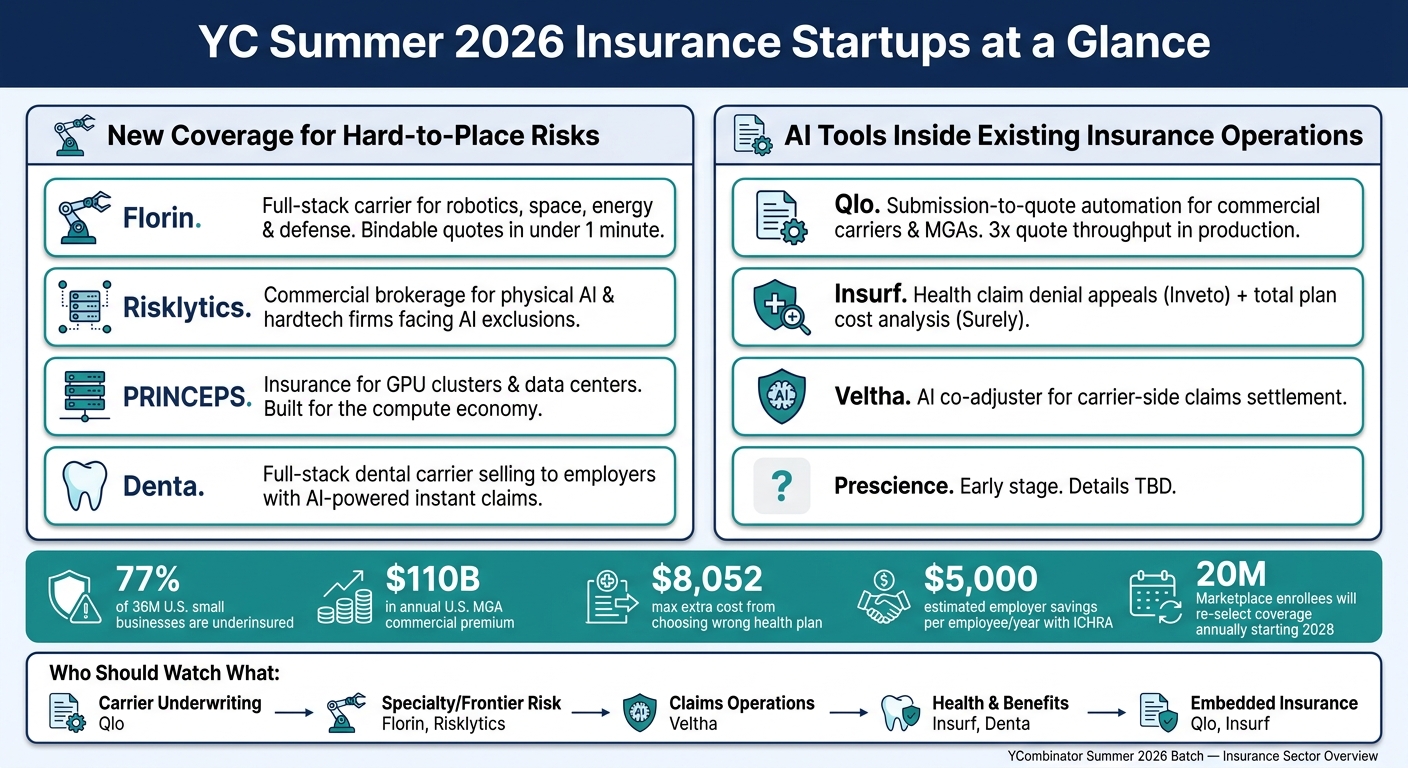
A few numbers stand out right away:
Startup
Main area
What it does
Best fit for
Florin
Frontier risk
Carrier for hard-to-place hardtech risks
Brokers, carriers, reinsurers
Risklytics
Frontier risk
Brokerage for physical AI and robotics firms
Hardtech brokers, AI firms
PRINCEPS
AI infrastructure
Coverage for GPU and data-center exposure
Infra partners, specialty carriers
Qlo
Underwriting workflow
Submission-to-quote automation
Carriers, MGAs, program admins
Insurf
Health benefits
Claim appeals + plan-cost decision tools
Employers, brokers, clinics
Denta
Dental insurance
Employer dental coverage with AI claims processing
Employers, benefits teams
Veltha
Claims
AI co-adjuster for settlement work
Carrier claims teams
Prescience
Unknown / early
Not enough detail yet
Watchlist
My main takeaway is simple: the strongest near-term fit is in workflow software and niche coverage. If you’re a carrier or MGA, I’d look first at underwriting and claims tools. If you’re in benefits, I’d watch Insurf and Denta. If you serve robotics, defense, or AI infrastructure, Florin, Risklytics, and PRINCEPS stand out fast.
Below, I’d break down where each company fits and who should care most.
Three S26 startups are going after frontier risks in robotics, AI infrastructure, and compute-heavy operations, where standard coverage keeps getting tighter. This is where AI underwriting shows up most clearly: in risks that standard forms struggle to price, or just leave out altogether. The ISO, which sets standards for about 70% of the U.S. market, is putting default AI exclusions into Commercial General Liability policies through ISO CG 40 47 / CG 40 48 [6].
Florin is a full-stack carrier for robotics, space, energy, and defense risks. Its AI model uses satellite imagery, public records, permits, and social media to generate bindable quotes in under a minute, while surfacing exposures that standard submissions often miss [1][3].
For carriers and reinsurers, Florin could be a way to work with novel risks they can’t price with much confidence today. For brokers, it may make hard-to-place hardtech accounts easier to place and move through the market.
Risklytics is a commercial brokerage for AI, robotics, and other hardtech companies that move, lift, drive, or power something [5]. That focus matters because these companies can run into renewals where AI exclusions quietly narrow coverage. For brokers handling hardtech or physical-AI clients, Risklytics looks like a practical resource for spotting those gaps before they turn into a problem.
"Physical AI is scaling faster than the insurance market underneath it. Insurance moves slower, and its first instinct with an unfamiliar risk is to exclude it." - Risklytics
That same mismatch doesn’t stop at robotics. It also shows up in the infrastructure behind AI.
Standard property and liability forms were not built for GPU clusters or hyperscale data centers, which leaves a growing exposure as AI compute buildout picks up [1]. PRINCEPS is focused on insurance for GPU clusters and data-center exposure, a niche tied directly to the buildout of the compute economy.
That puts it on the radar for carriers and infrastructure partners watching new property, liability, and business interruption exposure linked to AI compute.
Qlo and Insurf focus on the operating layer of insurance: intake, underwriting, claims, and plan selection. Instead of sitting at the product edge, they plug into existing insurance workflows. That makes them useful for carriers, MGAs, brokers, and employers that want automation without ripping out core systems.
Commercial underwriting has a familiar choke point: a single submission tied to a $50,000 annual premium can take up to 48 hours to become a quote when teams rely on manual steps [7].
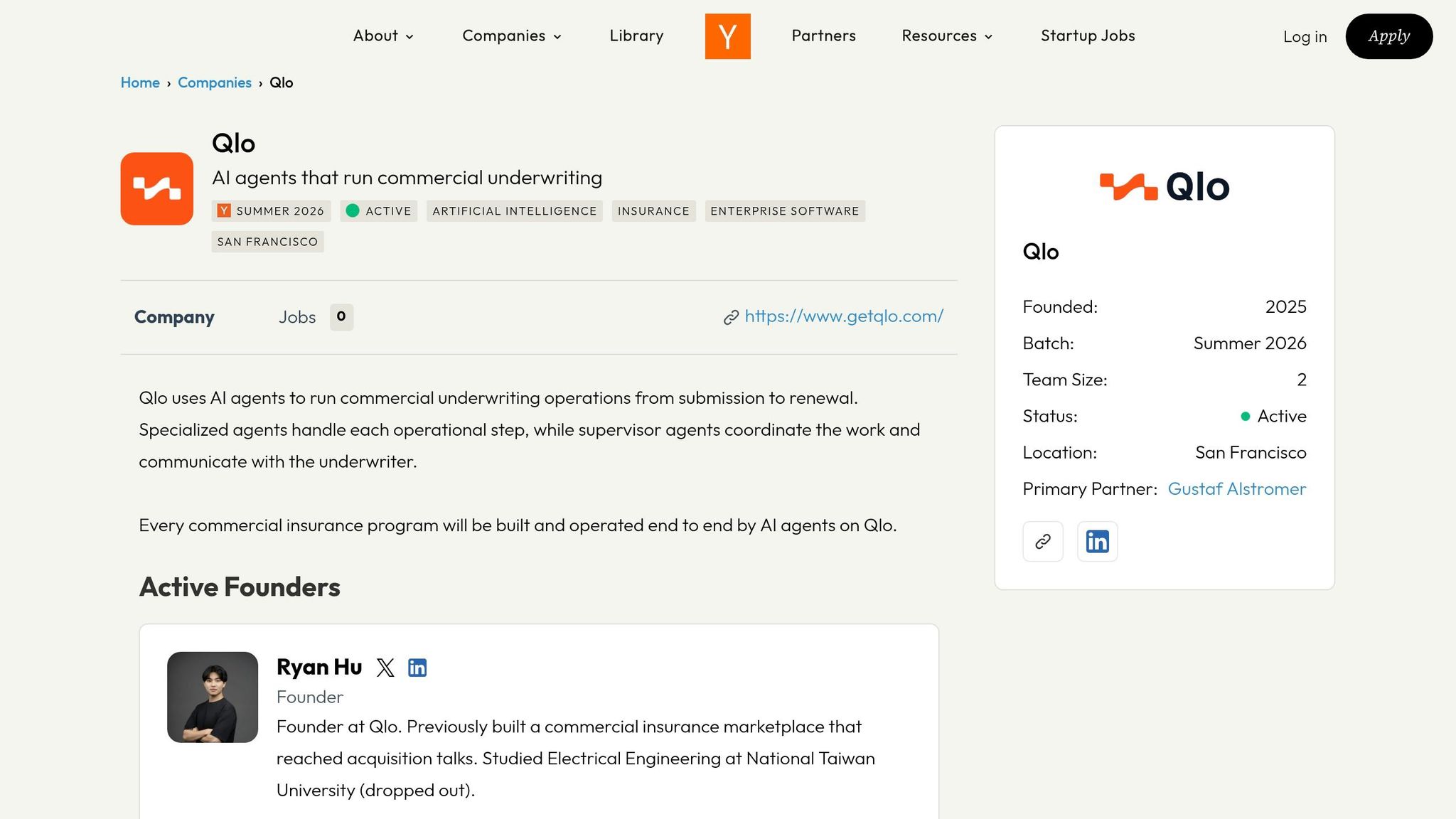
Qlo is built to fix that. Its setup uses AI agents and orchestration logic, including an Inbox Agent for submission intake and a Rater Converter that turns legacy rating spreadsheets into validated digital worksheets. The goal is simple: move a submission from intake to quote generation without manual hand-offs [7][8].
That shift is already showing up in production. In May 2026, Distinguished Programs Executive Lines went live on Qlo, led by President Ryan Becker. The team posted a 3x increase in weekly primary quote throughput, moving away from manual data entry and rater management toward a flow where agents handle the operational work while underwriters keep control of pricing and terms [7][8].
Qlo also works alongside existing policy administration systems. That matters because many carriers and MGAs want faster workflows, not a full system replacement. The company targets commercial MGAs and program administrators that run complex rating files in lines such as Executive Lines, including D&O, EPL, and Fiduciary. Its commercial offer includes a 30-day fully refundable paid pilot, followed by a flat fee for the first year of a two-year partnership [8].
The market it is chasing is not small. More than $110 billion in commercial insurance premium flows through U.S. MGAs each year [7].
Qlo is focused on commercial underwriting. Insurf goes after a similar pain point on the health side.
Insurf deals with denied claims, murky payer behavior, and a basic but expensive problem: figuring out what a health plan will actually cost before someone picks it.
Its two products work on both sides of that issue. Inveto automates health claim-denial appeals and prior authorizations. Clinics upload denial letters and clinical records, and the AI produces source-cited, physician-signed appeals ready for submission. As of August 2026, Inveto is active with specialty clinics across Texas, Georgia, and California [2].
Surely looks at total plan cost, not just premiums. That sounds like a small shift, but it changes the whole decision. For brokers and employers, Insurf turns a messy health-plan choice into a cost question.
Surely is built around one blunt finding: in a simulation of 2,000 years of health data, the plan with the lowest sticker premium was the lowest-cost option in 0% of cases [2]. Put differently, the cheapest-looking plan on day one can end up being the most expensive when care is needed. Choosing on premium alone can cost an individual as much as $8,052 more in a single bad year [2]. For employers weighing a move to ICHRA (Individual Coverage Health Reimbursement Arrangement), Insurf estimates savings of about $5,000 per employee, per year [2].
What gives Insurf’s model staying power is the link between its two products. De-identified outcome data from Inveto appeals flows back into Surely’s cost engine. That gives Surely a view into what plans actually cover versus what they say they cover [2].
The timing matters too. Starting in 2028, an estimated 20 million U.S. Marketplace enrollees will have to actively re-select coverage each year instead of renewing automatically [2]. That creates a clear decision-support gap for benefit brokers and employers.
Taken together, these startups show how insurers and distribution partners can add automation inside current workflows instead of rebuilding the entire stack.
The next layer is the product itself: dental coverage and claims settlement. That’s where these startups split into different lanes. Denta is focused on dental coverage, Veltha goes after claims settlement, and Prescience doesn’t have enough source detail yet for a solid profile.
Dental insurance has a built-in profit problem. Carriers can spend as little as 60% of premiums on patient care, and the U.S. market is worth about $100 billion per year.[1]
Denta is a full-stack dental carrier that sells straight to employers and uses AI to process claims instantly.[1] In plain terms, it’s trying to change both how dental plans are sold and how claims get handled once members start using them.
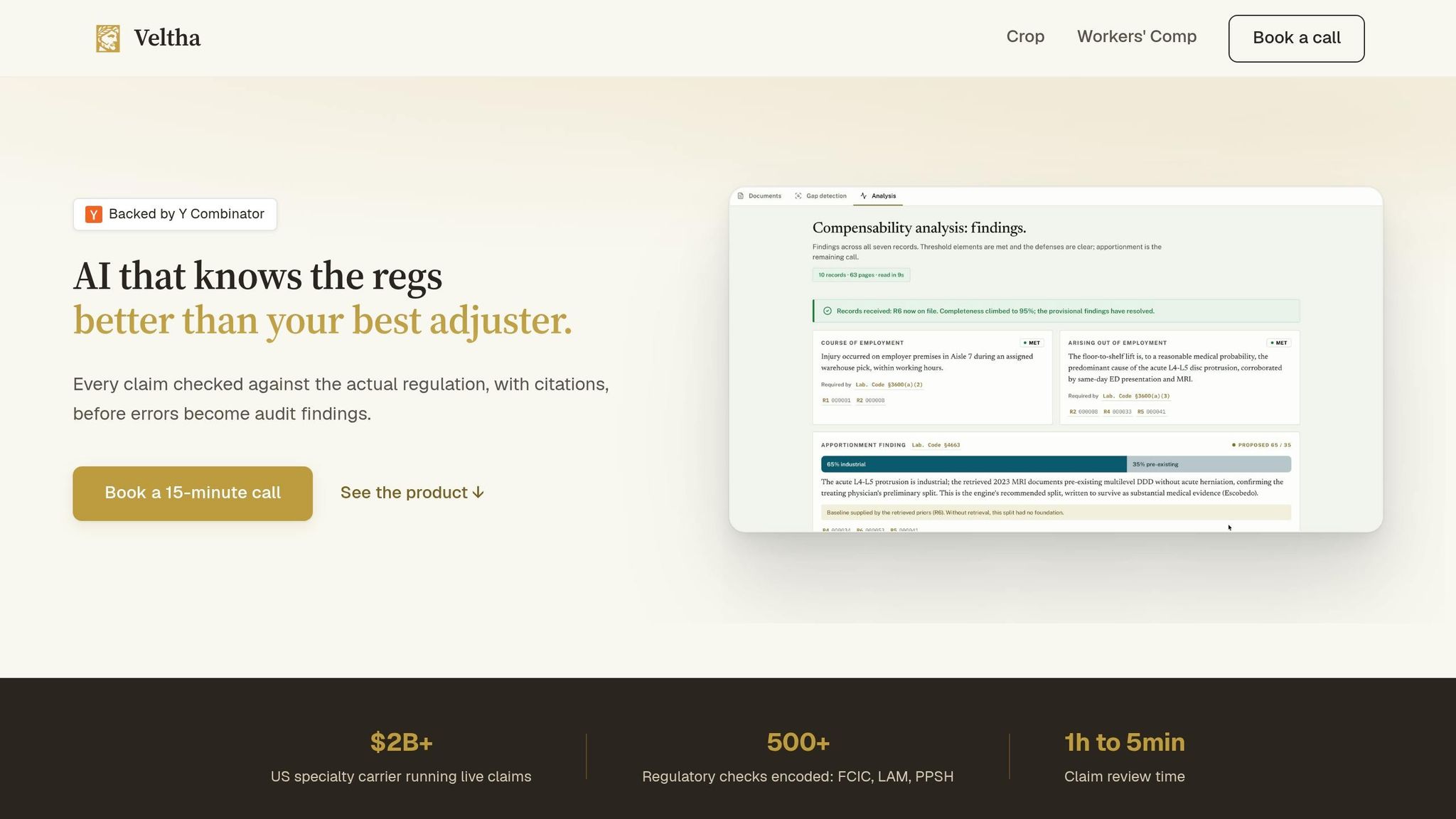
While Denta goes after pricing and distribution, Veltha is aimed at the back office side of claims. Veltha is an AI co-adjuster for carrier-side claims settlement, which means insurers can plug it directly into their claims operations.[1]
Prescience, at least for now, is harder to pin down. There isn’t enough source detail available for a reliable profile.
These startups point to two clear changes. First, AI is moving into the core of insurance operations. Second, the market is separating into two lanes: full-stack carriers on one side, and workflow infrastructure on the other.
Taken together, this group lines up with the parts of insurance that are most ready for API-driven integration. Frontier risks are pushing demand in specialty lines, while workflow tools are turning into the main connection layer across products and teams.
The next practical question isn't just what each startup does. It's where each one fits inside carrier, broker, MGA, or embedded insurance workflows.
The clearest openings depend on your spot in the value chain.
For commercial carriers, Qlo looks like the cleanest fit because of its autonomous underwriting infrastructure. For brokers and MGAs that serve SMBs, AI-led brokerage stands out most. About 77% of the 36 million U.S. small businesses are underinsured today because human-led brokerage can't profitably serve low-premium accounts. [4]
For health and benefits teams, Insurf's denial-appeal automation and plan-selection tools go after a direct cost issue by steering employers toward lower-cost coverage options. [2]
For embedded insurance teams, the main test is simple: can the product fit into current product and distribution flows through APIs? The best bets are startups with clean APIs that can plug into non-insurance products without forcing a system replacement.
This batch breaks into two groups: carrier-owning models and workflow infrastructure. One isn't better by default. The right choice depends on whether you want to replace part of a workflow or launch a new product category.
The fastest way to sort the batch is by buyer type:
If you work in…
Watch…
Why
Carrier underwriting
Qlo
Autonomous submission-to-quote workflows
Specialty / frontier risk
Florin, Risklytics
Coverage for robotics, autonomy, space, and other excluded risks
Claims operations
Veltha
AI co-adjuster for faster, defensible decisions
Health & benefits
Insurf, Denta
Denial appeals automation and full-stack dental
Embedded insurance
Qlo, Insurf
API-ready infrastructure with clear integration use cases
Frontier risks are getting more attention because autonomous tools like AI agents are moving into high-stakes business processes faster than the insurance market can keep up.
That creates a pretty clear problem. Legacy policies were not built for autonomous software, so coverage can be vague, limited, or left out altogether. At the same time, many long-established carriers don't have the data, technical depth, or response time to assess these risks well, which leaves businesses exposed.
They fit mainly by automating or wrapping the workflows and integrations teams already use. AI agents can take over manual brokerage and underwriting tasks, then connect with carrier tools and portals for quoting, COIs, and intake-to-issuance.
They can also plug into claims, benefits, and embedded distribution through APIs and structured data. And some focus on AI-related coverage gaps, using risk assessments and policies that sit alongside existing E&O and cyber coverage.