
June 26, 2026
Most financial wellness programs fail to address the immediate financial crises employees face. Tools like budgeting apps and financial coaching focus on long-term habits but don’t help when rent is due or a medical emergency strikes. Enter bill protection: a benefit that directly covers fixed expenses like rent, utilities, or car payments during events like job loss or illness. It provides immediate relief without requiring employees to change behaviors or navigate complex processes.
Here’s why bill protection stands out:
For employers, this isn’t just about helping employees - it’s about stabilizing the workforce and cutting losses from stress-related productivity drops. Offering bill protection could be the shift workplaces need to truly support their teams.
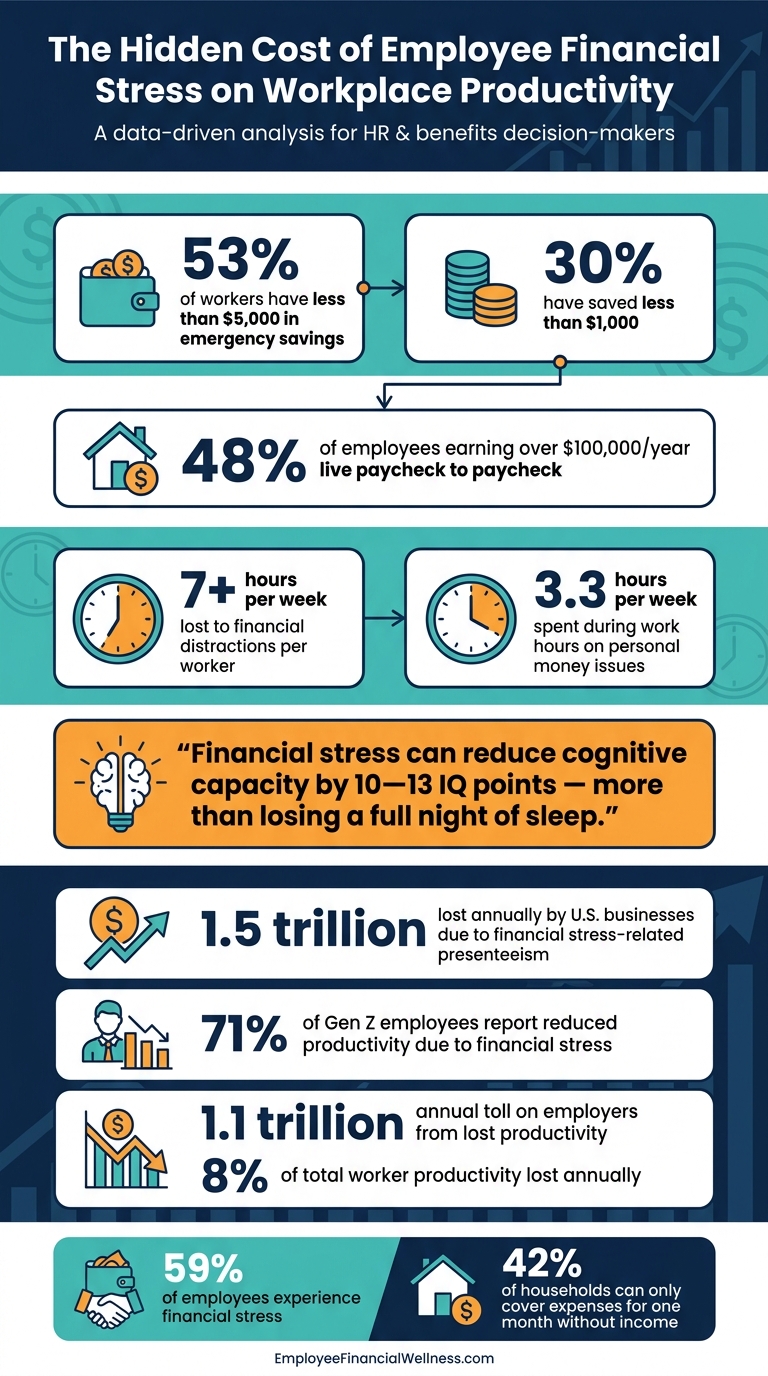
The financial struggles of the American workforce are more severe than many employers might realize. 53% of workers have less than $5,000 in emergency savings, and 30% have saved less than $1,000 [1]. This lack of a financial safety net means that even a single missed paycheck or an unexpected expense can throw many employees into crisis mode. Surprisingly, this issue isn’t limited to lower-income workers. Nearly half (48%) of employees earning over $100,000 annually are living paycheck to paycheck [3]. Financial stress cuts across income levels, affecting employees at all tiers of an organization.
When employees are financially insecure, their work performance takes a direct hit. On average, workers lose over 7 hours per week to financial distractions and spend an additional 3.3 hours during work hours dealing with personal money issues [3][6]. Multiply that across an entire workforce, and the productivity losses become substantial. Beyond lost hours, financial stress also reduces employees' ability to think clearly and focus.
This is tied to what experts call a scarcity mindset, where financial stress consumes mental bandwidth.
"The scarcity mindset created by financial stress can reduce available cognitive capacity by 10 to 13 IQ points. That is a more severe cognitive impairment than losing a full night of sleep." - Caroline Woodson, Author
In the workplace, this often manifests as presenteeism - employees who are physically present but mentally distracted. The cost of presenteeism linked to financial stress is staggering, with U.S. businesses losing an estimated $1.5 trillion annually [3]. Younger workers feel this impact even more acutely: 71% of Gen Z employees report reduced productivity due to financial stress [1]. For employers, this isn’t just a productivity issue; it’s also a retention challenge.
"Financial stress can be a business risk hiding in plain sight... revealing a workforce under sustained pressure, where day-to-day financial strain is undermining productivity, engagement, and long-term workforce stability." - PwC 2026 Employee Financial Wellness Survey
Altogether, the annual toll on employers due to lost productivity exceeds $1.1 trillion, representing approximately 8% of total worker productivity [5][6]. For HR and benefits teams, these numbers make a compelling case for introducing structural solutions like bill protection to safeguard workplace performance and stability.
Bill protection is a game-changer because it directly covers essential fixed expenses, bypassing the usual hurdles of traditional tools.
Here’s how it works: when a covered life event happens - like job loss, hospitalization, critical illness, or even death - bill protection steps in. It pays essential bills (think mortgage, utilities, or car payments) directly to service providers. The process is seamless: no claims to file, no calls to make, no waiting for funds to clear. And unlike savings or reimbursement plans, it doesn’t leave employees scrambling to cover costs in advance or worrying about falling into debt.
"Medical insurance pays providers. It does not pay the mortgage, the electric bill, or the car payment that continues arriving every month during a health crisis." - The Benefit Doctor
This simplicity and immediacy set bill protection apart from other financial tools, making it especially effective during times of crisis.
Many financial wellness tools sound great in theory but require consistent effort - something that’s hard to maintain for employees already under financial stress. Budgeting apps, savings plans, and similar tools demand ongoing commitment, and they’re often depleted or ineffective when a major crisis hits.
Bill protection, on the other hand, is effortless. It activates automatically when needed, without requiring employees to change their behaviors or plan ahead.
Feature
Bill Protection
Budgeting Apps / Savings Plans
Immediate upon trigger
Months or years to build
Low - automated
High - requires consistent action
Yes
Often depleted before a major event
Directly
Indirectly, if goals are met
No
Yes
The distinction is clear: budgeting tools are about education and preparation, while bill protection is about action. It acts like an invisible safety net, ensuring critical bills are paid when life takes an unexpected turn.
Bill protection doesn’t just help employees - it delivers real benefits to employers too. By relieving immediate financial stress, it allows employees to focus on their work instead of their bills. This reduction in financial anxiety leads to improved productivity, better engagement, and lower turnover.
When employees know their essential services - like housing, power, and internet - are secure, they’re less likely to fall into the scarcity mindset that drains mental energy. Instead, they can stay present and focused at work. Early data backs this up, with companies offering embedded bill protection reporting a 60%+ drop in churn rates among enrolled customers [4]. This shows that bill protection doesn’t just protect finances - it builds loyalty and stability.
"Embedded insurance has been promised for years. SymendPrevent is what it looks like when it actually works at scale. This partnership isn't incremental. It's a structural shift in who gets to participate in financial protection." - Adrien Niblock, Co-Founder, Walnut Insurance
Here’s another compelling stat: while only 18% of Americans currently carry income protection, 46% say they need it [4]. For employers, this gap is an opportunity to stand out. Offering bill protection sends a clear message: the company genuinely cares about its employees’ financial well-being, making it a powerful tool for both recruitment and retention.
Rolling out traditional benefits can be a slow and complicated process. It often involves lengthy vendor contracts, extensive employee education, and manual enrollment steps. Embedded insurance changes the game by integrating directly into systems HR teams already use, like payroll platforms and benefits portals. This means employees encounter coverage exactly when they're most likely to need it - during moments of financial risk. In fact, behavioral-science-led distribution models for bill protection have shown offer open rates exceeding 50% [4].
The best part? Employees don’t need a separate app, login, or even a conversation to access this benefit. It’s simply there when they need it. This kind of seamless integration allows for faster deployment, helping to turn financial wellness into financial resilience.
Walnut’s platform is designed with one goal in mind: making insurance easy to integrate, not a hassle to implement. Employers can choose from three integration options, depending on their technical capabilities:
Integration Option
Technical Requirement
Speed to Market
Customization
No-code
Days to weeks
Low (Walnut-branded)
Low-code
Days
Medium (pre-filled data)
Developer required
Weeks
Full native UI/UX
For HR teams looking for a quick setup, the Co-Branded Link Out option is ideal - it requires no developer involvement and can be launched in just a few days. On the other hand, the Headless API provides full customization and can trigger coverage automatically during events like job loss, offering a seamless experience.
Walnut also simplifies the process by connecting employers to over 14 insurance carriers, managing compliance, and providing instant quotes and binding. For example, in March 2026, Securian Financial launched FlexTech using Walnut’s platform. This allowed affinity groups and financial institutions to embed payment protection directly into digital experiences via API. The program covered disability, involuntary unemployment, and critical illness.
"FlexTech delivers the best of Walnut's sophisticated technology paired with Securian's deep protection expertise - enabling partners to meet evolving customer expectations with confidence." - Dave Seidel, Senior Vice President, Securian Financial
With these tools in place, HR teams can focus on the next step: planning a smooth launch.
For bill protection to deliver its full potential - like boosting productivity and retention - HR teams need to map out a thoughtful integration strategy. Here are some key factors to address before going live:
Traditional financial wellness tools often assume that simply providing information is enough to help people make the right decisions. But what happens when a missed paycheck puts someone at risk of losing their home? In those moments, behavioral tools and immediate solutions are often left out of the equation.
The numbers tell the story: 59% of employees experience financial stress [1], and 42% of households can only cover expenses for one month without income [2]. When a crisis hits, employees don’t need advice - they need urgent help to pay their bills.
This highlights a crucial difference: financial wellness focuses on improving habits over time, while financial resilience steps in during critical moments. Resilience tools provide immediate support during life-altering events like job loss, a medical diagnosis, or sudden disability. Programs like bill protection directly cover fixed expenses, ensuring employees don’t have to drain their savings, take on debt, or navigate complex claims processes when they're already overwhelmed.
This shift isn’t just about individual relief - it benefits employers too. Financial distractions lead to productivity losses, but solutions that deliver real results can make a big difference. Employees are 71% more likely to stay with an employer offering meaningful benefits [10], and financial resiliency rates jump to 79% with targeted tools, compared to just 55% with generic options [11]. The best part? These benefits often require no extra effort - they’re designed to activate automatically when employees need them most.
Bill protection insurance helps cover essential recurring expenses when your income is disrupted. This can include costs like rent or mortgage payments, utility bills, subscription services, and credit card payments. The goal is to ensure these obligations are taken care of during challenging times, such as job loss, serious illness, disability, or even death. Typically, payments are sent directly to service providers, so crucial services like electricity, internet, and phone stay active while you focus on getting back on your feet.
Bill protection kicks in during major life events that interrupt your ability to make regular payments. Common situations include losing your job unexpectedly, dealing with a critical illness, becoming disabled, being hospitalized, or even passing away. Some policies extend coverage to unique circumstances like gig workers losing platform access, needing to care for a sick family member, or disruptions in public transportation. When activated, this protection ensures bills are paid directly to service providers on your behalf.
Bill protection typically ranges from $3 to $10 per employee each month. These low-cost micro-premiums are a great fit for employees with fluctuating incomes. When this benefit is fully embedded - automatically included as part of the workplace offering - administrative efficiencies can help lower costs even further.