
June 29, 2026
A single late payment can drop your credit score by 60–110 points, and the consequences can last for years. Missed utility bills, often caused by short-term income disruptions like job loss or medical emergencies, can trigger late fees, disconnections, and even collection actions. This cycle damages credit scores, making it harder to recover financially.
Key Takeaways:
The solution? Bill protection. This service pays bills directly to providers during qualifying life events, keeping accounts current and protecting credit. It's a proactive way to stop financial harm before it starts, benefiting both consumers and service providers.
SymendPrevent, launched in April 2026, integrates bill protection into utilities, telecoms, and banks. Early results show over 60% reduction in churn and high adoption rates. With the right tools, the cycle of missed payments and credit damage can be avoided.
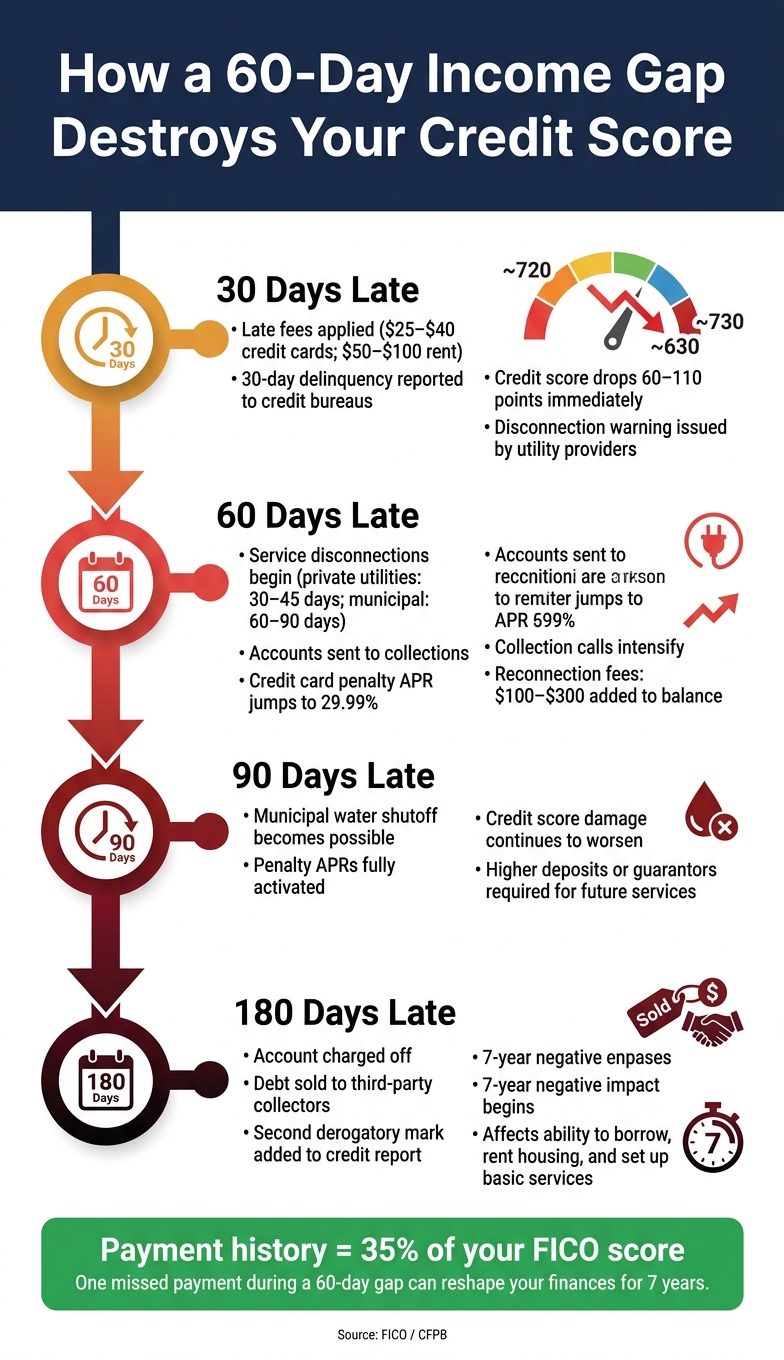
A 60-day income gap might seem like a short-term issue, but its financial effects can linger for years. Let’s break down how missed payments during this period can snowball into long-term financial challenges.
The moment a payment is overdue, the countdown begins. If a payment is 30 days late, it’s typically reported to credit bureaus, which immediately affects your credit score [1]. However, utilities like gas, electricity, and water operate differently. They don’t usually report monthly activity but will flag unpaid balances once they’re sent to collections - often after 60 to 90 days. At that point, a derogatory mark appears on your credit report. On the other hand, telecom providers, such as internet and cable companies, often report missed payments more quickly, with negative marks showing up almost immediately.
Beyond the initial hit to your credit, the financial strain deepens as fees and penalties accumulate.
Missing just one payment can set off a chain reaction of additional costs. For example, late fees on credit cards range from $25 to $40, while rent-related late fees can fall between $50 and $100 [1]. For utilities, the consequences escalate quickly. After 30 days, you might receive a disconnection warning. If the overdue balance isn’t paid, the service is cut off, and reconnection fees - ranging from $100 to $300 - are added to the bill [1]. Private utility companies often act faster than municipal services, disconnecting accounts within 30 to 45 days, compared to 60 to 90 days for municipal water services.
By the 60-day mark, the situation worsens. Credit card penalty APRs can jump to 29.99% [5], collection calls become more frequent, and accounts that remain unpaid beyond 180 days are charged off. These charged-off accounts are then sold to debt collectors, resulting in yet another derogatory mark on your credit report.
The financial consequences of a short income gap don’t disappear when your income returns. For instance, a charged-off account stays on your credit report for seven years, making it harder to borrow money, rent a home, or even set up basic services [4]. Increasingly, landlords, insurers, and utility companies rely on credit checks, which could lead to higher deposits or the need for guarantors [4].
Here’s a breakdown of how quickly a temporary income gap can lead to lasting financial harm:
Timeline
What Happens
Late fees apply; 30-day delinquency reported; credit score drops by 60–110 points
.
Service disconnections begin; collections initiated; delinquency flagged
.
Municipal water shutoff potential; penalty APRs activated; credit score damage worsens
.
Account charged off; debt sold to collectors; additional derogatory mark; 7-year impact begins
.
Payment history makes up 35% of your FICO score [6], making it the most critical factor. Even one missed payment during a 60-day income gap can have ripple effects, reshaping your financial future for years to come.
The financial damage we’ve discussed stems largely from reactive risk systems that only kick in after a problem has already escalated.
Think about late fees, disconnection notices, and collection calls - they all have one thing in common: they come into play after the damage is done. By the time a household receives a shutoff notice, they’re often already in financial distress. And when accounts land in collections, service providers face additional losses through write-offs and missed future revenue. For example, credit card charge-offs hit a 13-year high in 2026 [7], a clear sign of the pitfalls of treating missed payments as unavoidable rather than something that could be addressed earlier.
For service providers, this approach feeds into a cycle of involuntary churn - customers are forced out due to penalties, not because they want to leave.
On top of this, credit scoring systems make the problem worse. They fail to distinguish between temporary financial hiccups and long-term risk, which leaves many consumers unfairly penalized.
Reactive penalties are one issue, but credit models have their own blind spots. They often don’t account for the temporary nature of many income disruptions. These systems rely heavily on historical payment data, treating all missed payments the same - whether caused by a brief income drop or ongoing financial mismanagement. This one-size-fits-all approach overlooks a key fact: many income disruptions are short-lived.
Here’s a revealing statistic: only 18% of Americans have income protection, even though 46% say they need it [7]. When income dips, people miss payments, which drags down their credit scores. The result? Borrowing becomes more expensive, and climbing out of the hole becomes even harder - even after their income recovers.
Proactive solutions, like bill protection, could interrupt this cycle before it spirals into lasting credit damage. Instead of waiting for problems to snowball, these measures offer a chance to address issues early and keep both consumers and service providers on stable ground.
The earlier section highlighted how reactive systems fall short for both consumers and service providers. Bill protection flips the script by acting before a payment is missed, rather than scrambling to address the aftermath.
Bill protection is a micro-income insurance product built directly into essential billing systems like utilities, telecoms, and banks. When a qualifying life event occurs - such as job loss, disability, hospitalization, critical illness, or death - the coverage steps in to pay the customer’s bill directly to the service provider. This ensures accounts stay current without any interruptions [2].
Unlike general financial hardship programs, which often rely on discretionary approvals and inconsistent application, bill protection focuses on specific, verifiable disruptions that are temporary in nature. This proactive approach prevents debt from piling up and avoids the penalties that come with missed payments.
By paying the service provider directly, this system keeps accounts in good standing, protecting consumers from late fees and negative marks on their credit reports. This safeguards long-term credit health and provides peace of mind.
"SymendPrevent is the fix - the first solution that simultaneously protects existing revenue and generates new revenue from the same customer moment. In this economic climate, bill payment protection shouldn't be a competitive differentiator - it should be the standard." - Hanif Joshaghani, CEO and Co-Founder, Symend
In April 2026, Symend and Walnut Insurance joined forces to launch SymendPrevent, a distribution model for embedded bill protection designed for telecoms, utilities, and financial services across the US, Canada, and the UK. Early results were impressive, with deployments reducing churn by over 60% and achieving offer open rates above 50% [2].
Historically, one of the biggest hurdles for bill protection has been enrollment. If signing up involves a separate application, a phone call, or navigating an external insurance portal, many consumers - especially those who need it most - simply won’t follow through.
Walnut Insurance tackles this challenge with API-driven integration that embeds coverage directly into the customer experience. Depending on a partner’s technical capabilities, there are three main integration paths:
Integration Option
Technical Requirement
Deployment Speed
Data Capabilities
No-code
Days to weeks
Minimal data sharing
Low-code
Days
Pre-filled customer data
Developer required
Weeks
Full integration & automated triggers
The Headless API option offers the smoothest experience, allowing coverage to activate automatically based on real-time behavioral signals. Customers don’t need to manually file claims. For example, TELUS in Canada provides an optional bill payment protection service through Walnut Insurance. This product covers mobile bills for up to six months in cases of job loss or disability, all while keeping accounts in good standing [9][3].
"Embedded insurance has been promised for years. SymendPrevent is what it looks like when it actually works at scale. This partnership isn't incremental. It's a structural shift in who gets to participate in financial protection, and who gets to deliver it." - Adrien Niblock, Co-Founder, Walnut Insurance
This approach ensures that protection reaches consumers when they need it most, without requiring them to actively seek it out. Given that only 18% of Americans currently carry income protection, despite 46% saying they need it [2], this model addresses a critical gap. By simplifying enrollment and integrating seamlessly into everyday billing, bill protection strengthens financial stability and makes it easier for consumers to weather unexpected challenges.
Bill protection offers advantages that stretch far beyond simply avoiding credit score damage. It creates a ripple effect, positively influencing everyone involved in the billing chain. When payments remain on track during temporary income disruptions, all parties in the relationship benefit.
For consumers, staying current on bills helps dodge the domino effect of financial penalties that can destabilize their entire financial outlook. With direct bill payments, accounts remain current - there’s no 30-day delinquency mark, no 60-day mark, no collections referral, and no damage to credit scores.
But the benefits don’t stop at one account. A 2024 Urban Institute study, which analyzed data from five million consumers, found that utilities offering payment protection saw a drop in delinquencies across other credit types. Consumers were less likely to fall behind on credit cards, auto loans, or retail accounts, and they were also less likely to have debts sent to collections [8]. By keeping even one essential bill up to date, consumers can stabilize their overall financial situation, allowing them to allocate resources to other obligations.
For lenders, a financially distressed customer often signals trouble ahead. A missed utility payment today can easily turn into a missed loan payment tomorrow, and by the time the borrower hits 60 or 90 days past due, recovery costs skyrocket.
Bill protection shifts this dynamic. When a covered life event triggers automatic bill payments, the customer avoids entering the delinquency cycle entirely. This proactive approach at the utility level reduces downstream delinquencies across the lender’s entire credit portfolio [8]. The result? Fewer charge-offs, lower collection costs, and a more stable portfolio - all without requiring direct intervention from the lender.
Service providers also stand to gain by integrating proactive payment protection. Missed payments typically lead to late fees, service suspensions, and eventual disconnections - processes that are costly and often fail to recover the full amount owed.
Bill protection changes the game. Instead of writing off bad debt, the service provider receives payment directly through the insurance coverage. This ensures accounts remain active, customers stay connected, and relationships are preserved. Real-world results back this up: early implementations of SymendPrevent showed a 60%+ reduction in churn among customers who enrolled [7]. What’s more, service providers can generate new revenue through premium-sharing arrangements, often with no implementation costs [10]. This approach replaces reactive measures with proactive solutions, turning potential losses into long-term customer loyalty.
Building on the proven ability of bill protection to prevent credit damage, its successful implementation requires careful planning and execution.
Adding embedded bill protection to existing systems can be done in a variety of ways, depending on the technical resources and timeline available. Walnut Insurance provides three integration options, each catering to different levels of complexity and customization:
Integration Option
Technical Requirement
Customization Level
Speed to Market
Data Capabilities
No-code
Low (Walnut branded)
Days to weeks
Minimal data sharing
Low-code
Medium
Days
Pre-filled customer data
High (Developer required)
Full (Native UI/UX)
Weeks
Full data integration & automated triggers
The co-branded link-out is the quickest and easiest to implement, requiring no developer support and going live in just days. On the other hand, the headless API option offers a highly customized, native experience with direct integration into billing systems, enabling automated processes. Choosing the right integration model depends on balancing speed-to-market with the desired level of customization and data capabilities.
The best bill protection products are tailored to address the specific events that disrupt income - such as job loss, hospitalization, critical illness, or death. As of 2026, 85% of Canadians live paycheck to paycheck (up from 60% in 2025), and only 18% of Americans have income protection, despite 46% expressing a need for it [2]. These figures highlight the importance of addressing these gaps with well-designed solutions.
A key feature of effective bill protection is direct payment to service providers. This approach ensures accounts stay current, avoiding the credit damage that often follows missed payments. Timing also plays a crucial role. Research behind SymendPrevent, launched in April 2026 by Symend and Walnut Insurance, shows that offering protection during moments of financial stress - rather than at onboarding - leads to significantly higher engagement. In early trials, offer open rates exceeded 50% when the product was presented at these critical behavioral moments [2]. By aligning product design with real-world risks and offering it at the right time, bill protection can deliver maximum impact.
Three metrics provide a clear picture of success: churn rate, offer open rate, and credit score trends. Early results show that churn rates among enrolled customers dropped by over 60%, and offer open rates exceeded 50%, confirming the importance of presenting the product at the right time [2].
Longer-term metrics, such as credit score changes over 6- and 12-month periods, provide further insights. A stable or improving credit score indicates that the protection is helping customers avoid missed payments and the resulting financial penalties. Segmenting these results by high-LTV (lifetime value) customers highlights the return on investment for service providers, demonstrating how bill protection not only supports customer financial health but also strengthens long-term business relationships.
"SymendPrevent is the fix - the first solution that simultaneously protects existing revenue and generates new revenue from the same customer moment." - Hanif Joshaghani, CEO and Co-Founder, Symend
A 60-day disruption in income - whether due to job loss, illness, or hospitalization - can lead to a chain reaction of missed payments. This, in turn, damages credit scores, triggers collections, and leaves lasting financial scars. But here's the thing: this cycle isn't inevitable. It's the result of systems that react too slowly.
Bill protection steps in before a payment is missed. When a covered event occurs, bills are paid directly to service providers, keeping accounts current and credit profiles intact. This proactive approach avoids late fees, prevents collections, and stops financial stress from escalating.
With financial uncertainty on the rise, the importance of such measures has never been greater.
But bill protection doesn’t just benefit individuals. It also strengthens the broader billing ecosystem. By ensuring payments are made on time, it reduces customer churn, prevents bad debt for service providers, and lowers delinquencies for lenders. Everyone involved in monthly billing has a stake in keeping accounts up to date, and bill protection is the tool to make that happen.
Walnut Insurance’s embedded platform is proof of its impact. Since its launch in April 2026, it has achieved over a 60% reduction in churn and more than 50% offer open rates [2].
Stopping the cycle of missed payments not only safeguards credit but also reinforces the financial system as a whole. The infrastructure to prevent widespread credit damage already exists. The real question is whether providers will act now to adopt it - before the next missed payment happens.
Utility companies generally don’t include your monthly payments in reports to credit bureaus. This means your consistent, on-time payments likely won’t show up on your credit report. However, if you fall significantly behind on payments, your account could be sent to collections or charged off. When that happens, it can leave a negative mark on your credit report that lingers for up to seven years.
That said, there are services available that allow you to report your on-time utility payments, which could help boost your credit score.
Bill protection kicks in when major life events make it hard to keep up with essential recurring bills. These events typically include involuntary job loss, disability or illness (like critical illness or hospitalization), or even death. Some plans may also extend coverage to other situations, such as public transportation disruptions or the need to care for a sick family member.
Bill protection doesn’t have a direct effect on your credit score. That’s because most utility or subscription service providers don’t report your regular payments to the credit bureaus. So, even if you pay on time, it won’t give your score a boost.
However, it plays an indirect role in safeguarding your credit. By ensuring your bills are covered during times of income disruption, bill protection prevents missed payments from spiraling into collections - a situation that can leave a lasting dent in your credit history. Essentially, it helps you keep your accounts in good standing, shielding you from potential credit damage.